
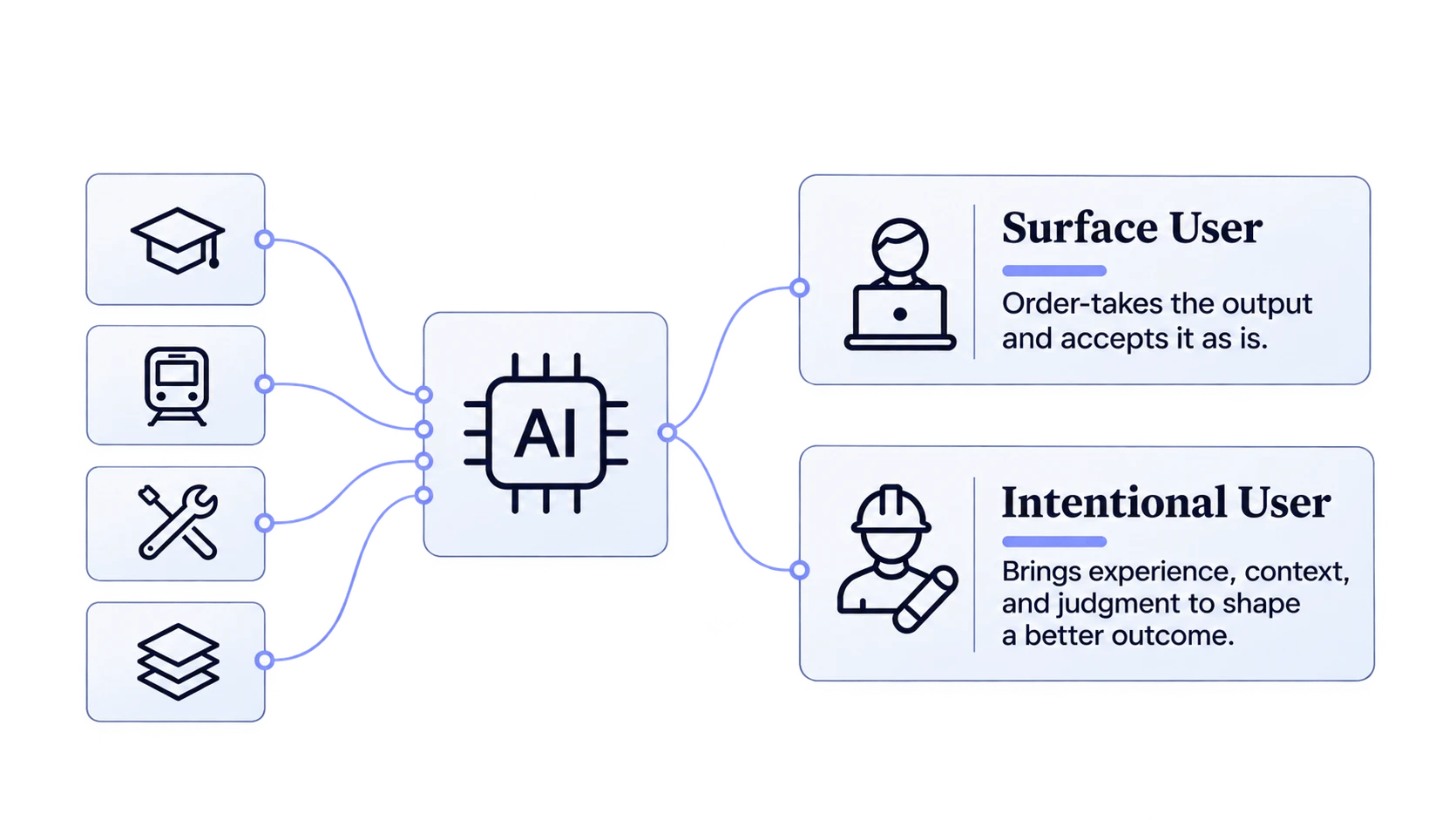
There’s an inversion happening that most people are missing. When something is coherent, structurally sound, and clear on a complex topic, it’s almost never because the tool is good. It’s because the writer has deep subject knowledge, repetition, and lived experience. That foundation is what allows ideas to flow, stay internally consistent, avoid circular logic, and land on a distinct point of view. When someone says, “Did ChatGPT write this?” they’re usually not reacting to polish. They’re reacting to slop. Generic framing. Meandering structure. No real point of view. And often, a writer who couldn’t tell what was wrong with the output, let alone fix it.
If you want to see this gap in the real world, go to the corner store. If my order is $6.53 and I hand the cashier $12.03, they often look at me like I have four heads. They have the register, the "calculator" to tell them exactly what to do, but they lack the structural logic to realize that the extra $1.03 gives me a clean $5 bill and fifty cents back instead of a pocket full of singles. They are Order-Takers for the machine. I am structuring the transaction, not waiting for the register to tell me what to do.
If someone lacks real domain knowledge, AI exposes them. They can’t steer the output. They can’t correct hallucinations. They can’t narrow the argument or drive toward a specific outcome. The result feels shallow because it is shallow. When AI is used by someone who understands the subject deeply, the opposite happens. The output becomes tighter and faster because the architecture already existed in the writer’s head. AI simply helps execute it. The insult works backwards. You can usually tell something was “written by AI” not because a tool was used, but because the human behind it lacked the depth to shape it. AI doesn’t magically create better thinkers. It makes the gap between clear thinking and shallow thinking far more visible.
Kids today are used to zero friction. Everything delivered to the door. No reps required. I often apply situational friction with my daughter. I don’t default to convenience. I take the train instead of calling an Uber. These are the structural reps I apply to teach her the architecture of the system.
Last Saturday, my daughter was craving ramen, so we took the train into the city. Penn Station sits between 7th and 8th Avenue, and the easy move is to stay inside the concourse and grab the ACE because it’s right there on 8th. Ippudo is on 4th and 10th. Anyone who knows the system understands the ACE runs north and south on the west side. If I step out to 7th, walk one avenue to 6th, and take the NQR to Union Square, I land directly on 4th. One avenue of friction at the start saves five avenues at the end. That is productive struggle working against performative friction, taught in real time.
This is where most critics miss the point. They worry about atrophy, the idea that if the LLM writes, the human forgets how to think. But for the intentional user, the opposite can happen. An LLM becomes a horizon scanner. It surfaces concepts, language, and structural variations at speed, allowing you to evaluate and refine faster than you could alone. It doesn’t replace your thinking; it stress-tests it. The difference is expansion versus replacement. If you already have depth, the LLM amplifies it. If you don’t, it exposes the absence. The LLM doesn’t supply judgment. It accelerates whatever judgment already exists. Just like the calculator didn’t teach you math, it accelerated the math you had already learned.
You can frame this another way. It becomes obvious who has lived experience, stewardship, and judgment, and who doesn’t. People without a clear understanding of the intended outcome, whether operational or strategic, tend to accept whatever the LLM produces. Those with real depth interrogate it. They reshape it. They know what the output is supposed to achieve and how it was derived. That discernment only comes from productive struggle. Many entry-level professionals today were given speed before they were given reps. Gen X experienced both performative friction and productive struggle. The struggle-built pattern recognition and instinct. The friction was just noise. AI moves fast enough to remove the noise and expose the difference.
This is why the insult lands the way it does. When someone says, “It looks like AI wrote that,” what they’re really saying is that the writer never acted as the architect. They didn’t know enough to frame the objective, choose the materials, or evaluate whether the structure made sense. The surface user is the order-taker. They ask the LLM for a “house” and accept whatever appears. The intentional user is the architect. They understand climate, load-bearing walls, wiring, and long-term durability. They decide which windows belong in that environment and which don’t. The LLM is just the power tool. It speeds up construction. It doesn’t design the structure.
We are moving away from a world of content creators and toward a world of systems architects. Slop is the professional equivalent of leaving a job site with exposed wiring and a leaking roof because no one knew enough to inspect the work. If you can’t tell what’s wrong with the output, you shouldn’t be the one holding the tool.
The Intentionality Gap is where this era will separate people. It will define who chooses to engage deeply and who chooses to outsource their thinking. AI sits inside that outcome. And like the old saying goes, you get out of it what you put into it. That’s the definition of productive struggle.