
Gen X sits in a uniquely advantaged position in the AI era, and it’s not because we’re inherently wiser or more adaptable. It’s because we lived through both systems. We started our careers on desktops, not laptops. If you wanted email on the go, you carried a phone and a BlackBerry. Most work lived on a hard drive, not in the cloud. We had to learn the slow version of everything before the fast version existed. That overlap created an ability younger generations are scrambling to build and older generations often never internalized: the ability to tell what’s real.
We learned judgment the long way. Not because we wanted to, but because the work forced it. You couldn’t Google your way out of a problem. You couldn’t fire off a message and expect an instant reply. You couldn’t rely on a tool to generate the first draft. You did the work yourself. You made the mistakes yourself. You figured out the pattern by living through the consequences. And when digital tools arrived, they made us faster — not lazier — because we already understood the mechanics underneath.
Younger generations entered the workforce after the scaffolding had already been removed. They inherited speed without context. They got tools before they got reps. And none of that is their fault; it’s structural. Companies stripped out the struggle and kept only the deadlines. They created work environments where people produce more but learn less. They unintentionally raised a generation of workers who can move quickly but never had space to develop the instincts that tell you when the quick answer is the wrong one.
AI widens that gap. It rewards the people who already know how the work behaves underneath. It accelerates the people who built their judgment before shortcuts existed. It punishes anyone who tries to skip straight to output without the foundation. And it exposes the people who don’t know how to evaluate what the tools produce.
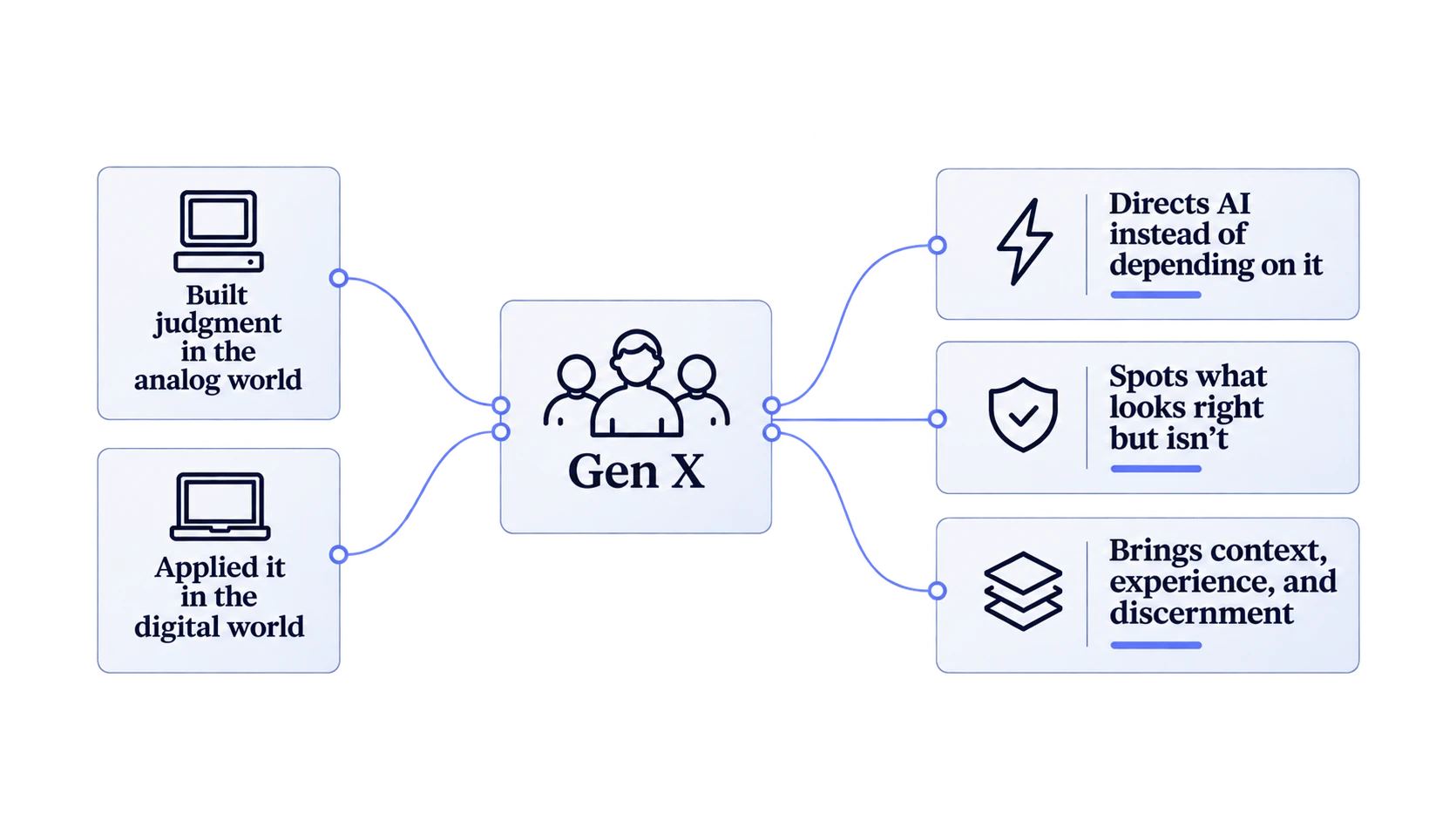
That’s why Gen X has an unfair advantage. We built our judgment in the analog world and applied it in the digital one. Now we can direct AI instead of depending on it. We can tell when an answer looks right but isn’t. We can sense when something is missing even if the text is polished. AI doesn’t intimidate us because we don’t mistake speed for understanding. We’ve seen fast systems break before, and we know what failure looks like underneath the shine.
This isn’t nostalgia. It’s structural reality. The people who learned the work the long way are the ones most capable of using AI the right way. Not because we’re better — but because we trained under conditions that built the one skill AI can’t replace: discernment.
Gen X didn’t ask for the advantage. But the era handed it to us. And in the world AI is creating, it matters more than ever.