
The Reckoning AI Just Triggered
Leadership is weakening inside a lot of organizations. It’s not because people don’t care or aren’t capable. The problem is simpler. The conditions that used to build judgment aren’t there anymore. Early roles once forced people to think, revise, and try again. Those reps built the instincts leaders rely on later. Over the last decade, most of that work has disappeared. Automation, tools, and lean teams stripped out the struggle. People moved up faster, but without the depth those roles used to demand. Tools made it easier to produce work quickly, but they didn’t teach anyone how the work operates underneath. And when people skip the early stages of the work, they also skip the experiences that teach them how to make sound decisions later. That’s not a talent gap. It’s a structural one, a hole in the system. The apprenticeship ladder collapsed, and nothing stepped in to replace it.
Anyone who has ever inherited a team built during a hiring surge has seen the consequences. If you remove the work that builds judgment but keep the expectations that rely on it, people get exposed. They can execute quickly, but they stumble when the situation isn’t straightforward. Teams hit deadlines, but the thinking behind the work is thin. That’s what happens when an organization optimizes for speed instead of development.
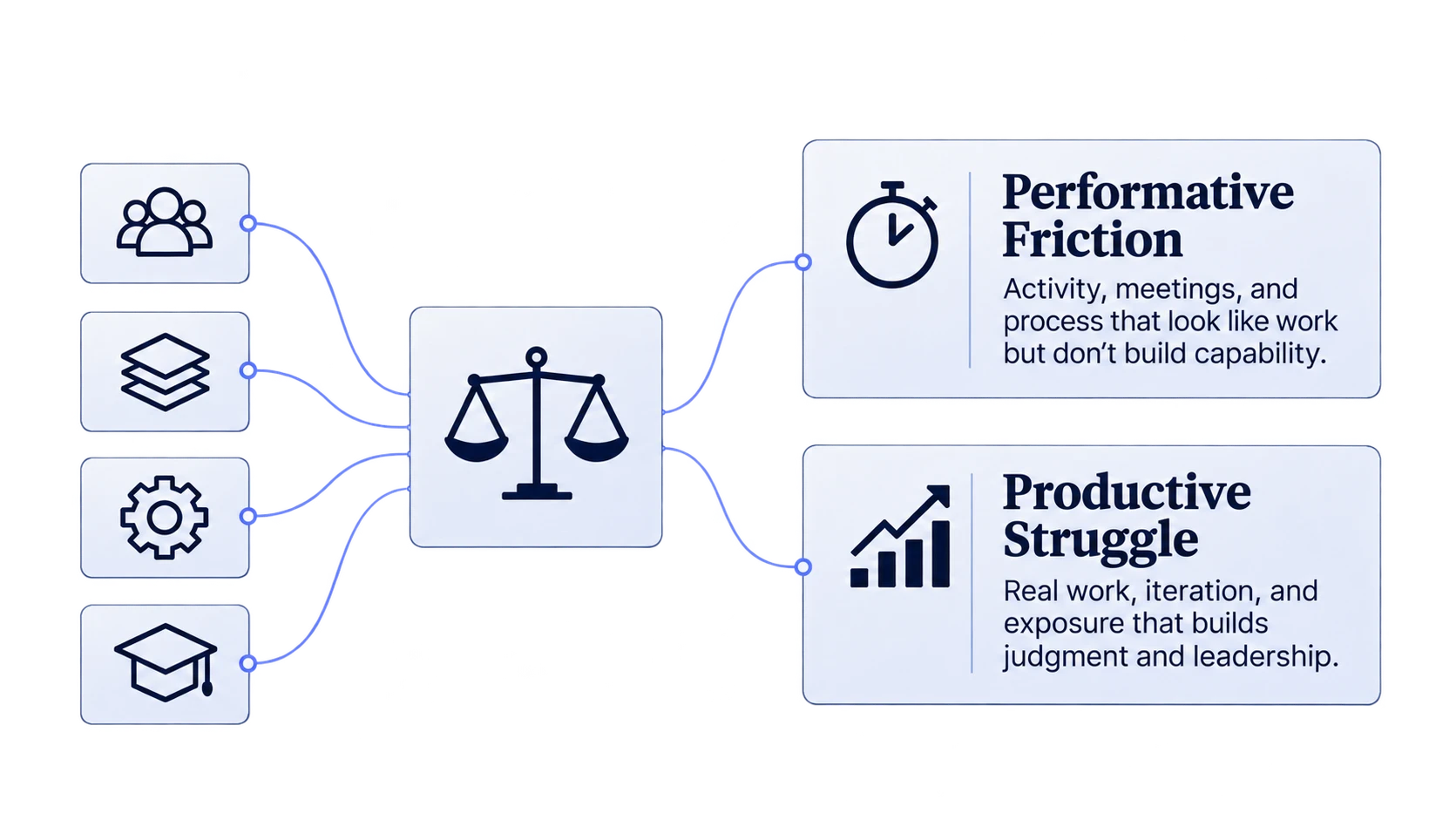
Most companies still can’t tell the difference between productive struggle and performative friction. Productive struggle is where judgment is built. Performative friction is where time gets wasted. But companies keep the friction and cut the struggle. They protect the noise and eliminate the work that creates skill. Now AI is accelerating this imbalance. It strips away the busy work and makes it obvious who built their instincts the hard way and who never got the chance.
Productive struggle has always been the foundation of expertise. It’s the messy early work, the things you get wrong, the do overs, the stretch of time where patterns finally start to click. That’s how people learn to operate without a script.
Performative friction looks like hard work, but it isn’t. It’s meetings no one needs. It’s layers of process that stall progress under the label of "alignment." It’s decks that replace real thinking. Its late nights meant to signal commitment instead of real clarity.
That’s the trap many organizations fell into. They kept the rituals that waste time and cut the work that creates capability. In doing that, they also protected the weakest operators, because the friction gave them cover. And once the friction became the default operating environment, those same weak operators moved up because the system rewarded navigation, not understanding. When AI enters this setup, it doesn’t just automate tasks. It removes the friction that once hid gaps in thinking. The work becomes clearer. The output becomes visible. And you see very quickly who knows what they’re doing.
AI isn’t replacing competence. It’s revealing it. It collapses fake timelines and wipes out the repetitive tasks people used to hide behind. When the smoke clears, what’s left is the thinking, and the gaps become impossible to ignore.
AI makes productive struggle more important, not less. When work speeds up, the real skill isn’t producing output. It’s knowing whether the output makes sense. AI can give you an answer, but it can’t tell you if the answer is believable. Only someone who’s done the foundational work has the instincts to catch hallucinations, bad assumptions, or contradictions inside a polished answer. Because productive struggle builds something AI can’t replicate, the ability to tell what’s real. Just like you can’t skip early math and expect to understand what the calculator is doing for you, you can’t skip the foundational work inside companies and expect AI to make up the difference.
This is the gap most people don’t see. If you’ve spent years analyzing data, you know when a number is off before you can explain why. If you’ve built forecasts manually, you can feel when a model contradicts itself. If you’ve written strategy decks from scratch, you know when the narrative structure is wrong even if the sentences look polished. Those instincts come from reps, from doing the slow, sometimes boring version of the work long enough for the patterns to sink in.
Without that background, AI becomes a trap. The output looks sharp. It sounds confident. It carries authority at first glance. But if you have never learned how the work behaves underneath, you have no way to judge whether what you’re seeing is real or nonsense. That’s why people with real experience catch errors instantly, while people without those don’t even know what to question. AI doesn’t level the field. It widens the gap between people who can tell what’s real and people who don’t.
When organizations remove early career struggles, they take away the only thing that teaches people the ability to tell what’s real. In a world where AI moves fast, that gap becomes a liability. Not because the work is harder, but because the mistakes are easier to miss and far more expensive when they land.
This is why productive struggle matters more now. AI speeds everything up. When execution is fast for everyone, judgment becomes the differentiator. Anyone can produce more output with the right tools. But AI can’t give someone the structure of thought that comes from years of reps. That structure is what lets someone evaluate an AI output, spot what’s off, and adjust it. Without it, people move quickly in the wrong direction.
A lot of companies don’t see this. They assume AI means early struggle is no longer necessary. They think faster tools equal faster development. So, they cut foundational tasks, shrink roles, and expect people to figure it out in jobs they’re not prepared for. But removing the struggle doesn’t create stronger employees. It creates people who never built the intuition their jobs require.
You can already see the impact inside teams that scaled quickly. Work moves faster, but not necessarily smarter. Decisions come quicker, but not better. Work ships on time, but only when the problem fits the template. When it doesn’t, people freeze. That’s not a talent problem. That’s a system problem. Talent never had the conditions to become judgment in the first place.
Organizations that understand what’s happening won’t respond by removing developmental reps. They’ll put them back. They’ll give people real problems instead of templates. They’ll let early career employees be wrong in ways that teach them something. They’ll assign leaders who explain their reasoning instead of hiding behind authority. They’ll build workflows that demand repetition and reflection, not just output.
Development doesn’t happen because someone gets a bigger title. It happens because someone has done enough meaningful work to build the ability to tell what’s real. AI doesn’t change that. If anything, it raises the bar.
The companies that see this clearly are already moving differently. They’re cutting the friction that adds nothing. They’re protecting the struggle that builds capability. They’re training people to think, not just execute. They’re rebuilding apprenticeship instead of pretending it’s outdated. They’re developing judgment on purpose.
AI didn’t break work. It exposed how competence is built and how quickly it falls apart when the wrong parts of the system get optimized away. The companies that act on that truth will build leaders who can operate with clarity in a faster world. The ones that don’t end up with people who move fast but can’t think deeply enough to lead.