
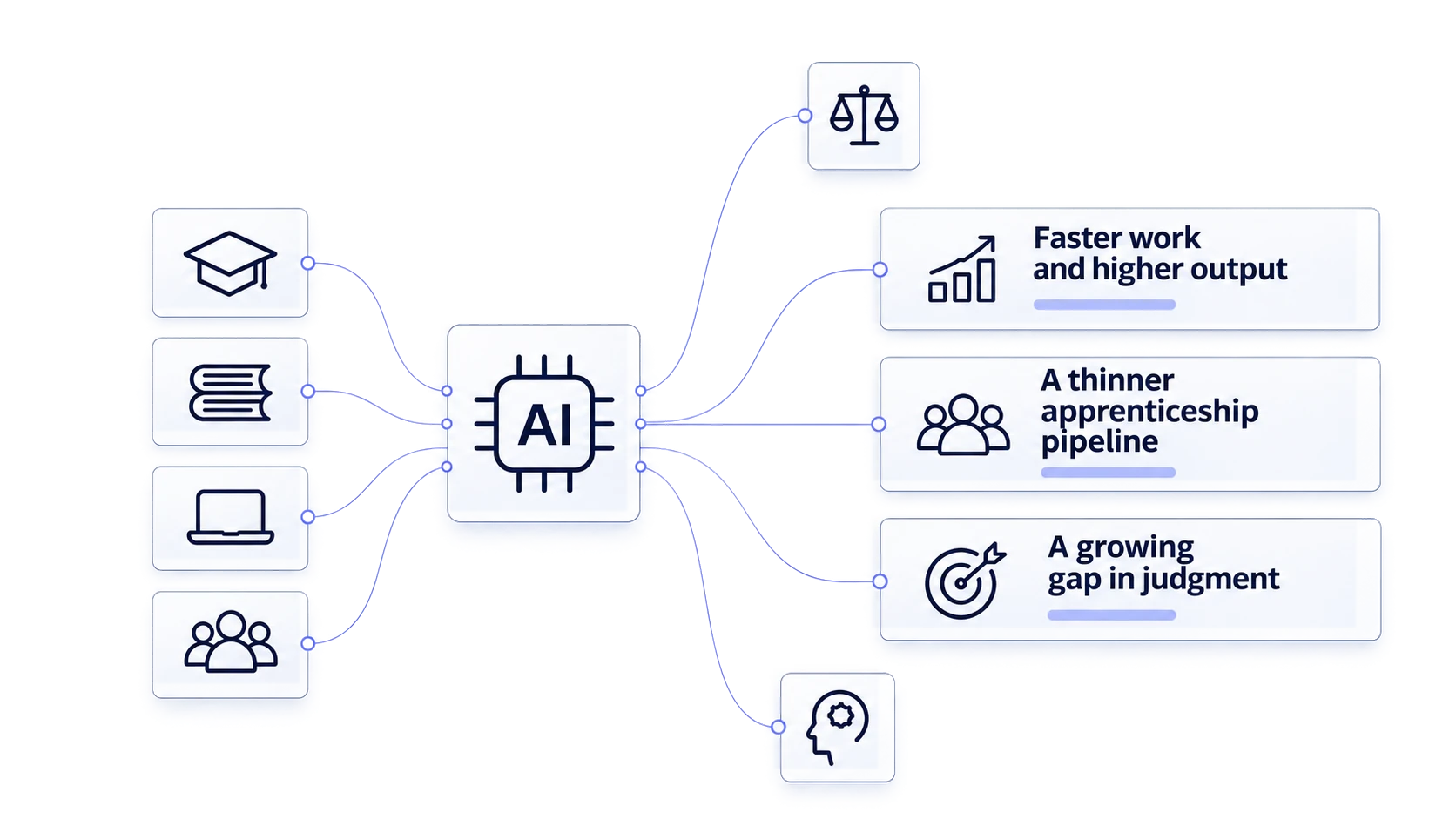
We are worried about the wrong thing. Everyone asks if AI will replace jobs, automate tasks, or shrink teams. They’re missing the point. It is about the collapse of the pathway through which expertise has always been formed. AI is not disrupting work. It is disrupting the developmental stages that produce judgment. And judgment is the single defining trait of leadership.
I understood this clearly when trying to explain AI across generations. My daughter, my parents, my nephews, colleagues in their twenties, senior leaders in their fifties, everyone needed a way to understand AI without jargon or abstraction. The analogy that cut through all of it was the math progression we all lived through in school. In third grade, you grind through addition and subtraction. In fourth grade, you struggle through long division. In fifth grade, you learn fractions. By sixth grade, you are showing your work on every multi-step problem. Those years of repetition build the logic your brain relies on. Only later, around seventh or eighth grade, does the calculator become part of your workflow. The calculator didn’t teach you math. It accelerated the math you already knew. That is exactly how AI works today. AI is a calculator layered on top of years of foundational thinking.
I see this dynamic clearly inside my own work. I have ADHD. I thrive on speed, complexity, and pattern recognition. But mechanical, repetitive tasks drain me. Before AI, the strategy was never the slow part. The slow part was everything required before the strategy could begin, synthesizing inputs, building context, framing narratives, and structuring the foundation for decision-making. I always delivered high-quality work, but I had to choose which major initiative would move forward first because the groundwork consumed so much time. AI didn’t change my intelligence or my instincts. It changed the pace at which strategic thinking could move because it compressed the friction underneath it. AI didn’t give me talent. It gave me margin. And margin is where better decisions happen.
I spoke with Carter, the Commercial Lead at Umbrage, a Bain Capital, owned product design firm. I reached out after hearing him on a panel because his framing was sharp, grounded, and honest in a way most AI conversations aren’t. While on the panel, he said something that stopped me: the real threat of AI isn’t job loss, it’s apprenticeship loss. Senior leaders today can immediately tell when an AI output is wrong because we spent years doing the foundational work ourselves. We lived through the third-, fourth-, fifth-, and sixth-grade phases of our careers. We built instincts through repetition, tension, and correction. But if AI replaces the entry-level roles where those instincts are formed, what happens when the next generation reaches senior positions without ever developing the intuition those roles require? That question exposes the actual risk: AI accelerates work in a way that breaks the developmental ladder future leaders need.
I saw this again recently during a forecasting review. The model generated three separate graphs, daily, weekly, and monthly, all accurate but disconnected. It was a precise output with no understanding of how decision-makers interpret information. I told the model it could collapse all three into one graph simply by swapping the axis. That moment illustrated the split perfectly. AI provided the data. Human judgment provided the structure. AI can compute, follow instructions, and generate volume, but it cannot yet understand human cognition or why clarity often matters more than accuracy alone. That is where expertise becomes irreplaceable.
This is the part of the AI conversation that gets overlooked. AI is accelerating every part of professional work except the one thing that defines leadership: the development of judgment. Judgment cannot be automated, outsourced, or rushed. It is built through repetition, exposure, friction, mistakes, and context, all the elements AI compresses or removes. The disruption is not happening inside the tasks themselves. It is happening inside the developmental pipeline that produces senior capability.
This is where we need to separate productive struggle from performative friction. Productive struggle is the grind that builds judgment, the repetition and mistakes that create pattern recognition and instinct. Performative friction is something else entirely. It’s the stay-late culture, the drawn-out workflows, the long-hours theater that once hid incompetence behind effort. AI destroys performative friction instantly, which is a good thing. But if we aren’t careful, it also risks destroying the early-career struggle that actually develops leaders. That’s the paradox: we need AI to eliminate inefficiency, but we cannot let it eliminate the apprenticeship that creates judgment.
That truth exposes something we rarely say out loud. For decades, professional culture equated “time spent” with “wisdom earned.” If someone worked until eight or nine at night, we assumed they were more capable. AI breaks that illusion. Long hours do not automatically signal competence. They can just as easily signal inefficiency, lack of clarity, or reliance on volume to mask the absence of depth. AI strips away the friction that once protected that illusion. It reveals who understands their craft and who depended on the slowness of the work to disguise a lack of judgment.
This is why the calculator analogy matters. The calculator made trained minds faster. It didn’t make untrained minds better. AI is the same. It amplifies people who already built their fundamentals. It accelerates clarity for people who already know how to think. What it cannot do is supply judgment. And judgment is the currency of leadership.
Let's be clear: AI isn't replacing the competent. It is exposing the truth about competence. It is forcing us to confront how expertise is built, how leadership is earned, and how much of professional culture relies on confusing long hours with genuine capability. AI doesn’t diminish real expertise. It makes it undeniable. It doesn’t erase foundations. It demands them.