
If Part 1 was about why the funnel collapses, this is about what replaces it. Traditional Google style search monetization works because the system is built on stable, repeatable surfaces. Queries produce SERPs, and SERPs produce ad slots. Ads live adjacent to answers, not inside them. Users expect to scan and choose, and the system can tolerate a lot of inefficiency because massive volume covers for it. Waste is acceptable when scale feels infinite.
AI assistants break every one of those assumptions. A system like ChatGPT, Gemini, or Grok doesn’t really “return results.” It settles intent. That single shift fundamentally alters what can be monetized. When a user asks, “What’s the best checking account for a freelancer?”, the LLM is not generating ten blue links and four sponsored placements. It’s producing one recommendation and at most a fallback. The question doesn’t create inventory. It creates a decision moment.
This shift is critical because traditional inventory is effectively vanishing. Without fixed ad positions or guaranteed impression counts per query, the model shifts from monetizing pages to monetizing moments of resolution. Consequently, as users consume less discovery and consideration content on publisher sites, impressions will drop dramatically. With fewer placements available, each one carries more weight. This reduced surface area is exactly why AI monetization cannot simply scale like search advertising; resolution inherently compresses opportunity
That doesn’t mean there is no marketplace. It means the marketplace looks different. Classic search advertising is auction based and priced around attention. AI monetization has to be intent qualified and trust constrained. A pure bidding system would be suicidal. If the highest bidder keeps producing bad outcomes, the assistant’s credibility erodes. That’s an existential risk for the platform.
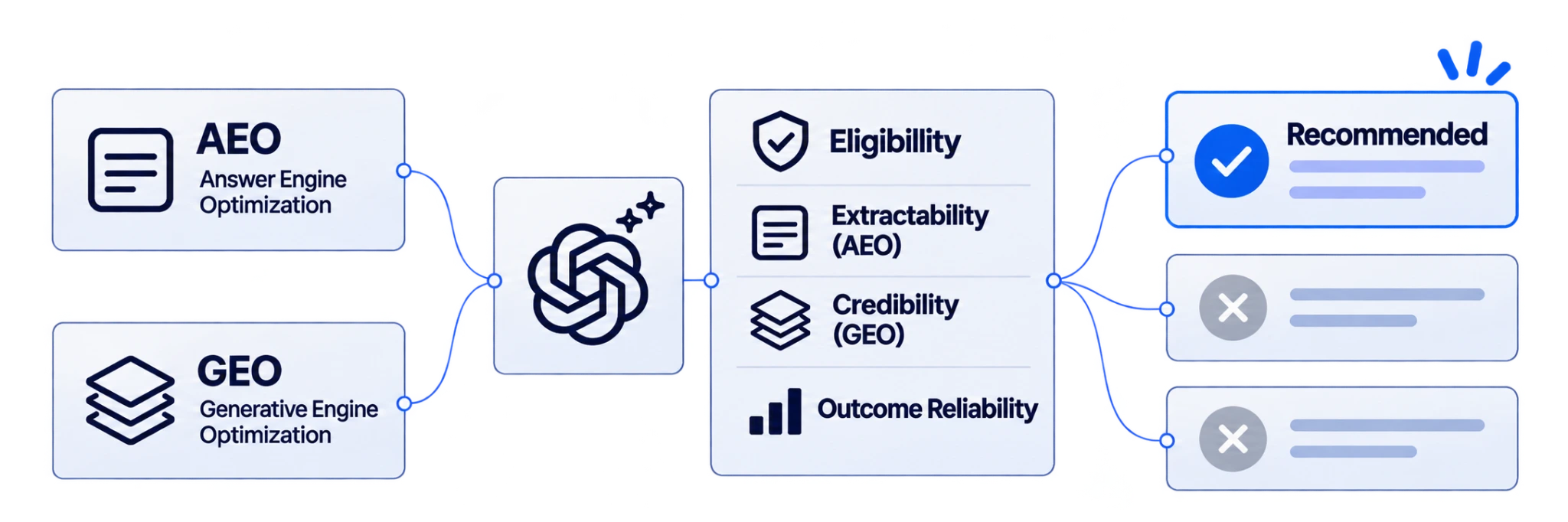
Instead of open auctions, we get something closer to eligibility first economics. Money comes second. Structurally, this starts to look like a layered system rather than an open exchange. First, brands have to qualify before commercial influence even matters. They need to be in the right category and demonstrate decent outcomes. A lot of advertisers never make it past this filter.
Once eligibility is established, contextual fit takes over. The assistant evaluates the user’s intent and stated preferences. This is not keyword matching. It’s situational matching: is this product appropriate for this person in this specific job? Only after that does money enter the picture, and even then, it’s constrained. You don’t buy your way into a recommendation; you compete inside a narrow band of acceptable options.
Every recommendation then feeds back into the system. If users churn or express regret, that option loses influence quickly. So yes, AI monetization is still biddable, but not openly. The mechanics look less like classic Google Ads and more like cost per action completed or revenue share. You’re not bidding for attention. You’re bidding for permission to be chosen, and that permission is continuously re earned.
Distribution under this model consolidates hard. Instead of millions of publishers, you get a small number of assistants handling high intent decision moments. Each moment has very few winners. If you’re not selected, there is no fallback impression on some other page. The assistant doesn’t scroll.
Early on, users will still see multiple options because trust is still forming. Over time, low risk queries will collapse to a single default. High risk / trust prompts will keep more visible comparison, but inside strict boundaries. There is still a marketplace, but it is not infinite and not tolerant of low quality outcomes.
To put it bluntly, AI monetization is not an extension of search advertising. It is a different economic system. Search monetized uncertainty. AI monetizes resolution. Apply that logic to the broader display and programmatic ecosystem, and the implications get ugly. For search, this is a transformation of how we buy. For display, it’s a crisis of where we buy.
The surface area collapse kills inventory. Programmatic thrives on waste. It requires you to visit five travel blogs just to plan a weekend trip. Those visits create the slots. If an AI resolves intent in one go, you never visit the blogs. Search queries might stay flat but clicks drop. For display, the placement just vanishes. The “long tail” of the internet starves.
Then there’s the retargeting loop. That’s a dagger to the heart of the display industry. Right now, if you look at shoes and don't buy, banner ads chase you for two weeks. In an AI world, if the assistant acts as a decision engine, you aren't browsing. You’re deciding. If you reject a recommendation, the AI offers a different one immediately. It doesn't let you leave indecisive. You can't follow a user who isn't wandering.
Display is forced to retreat from “performance” back to “brand.” Since display ads can’t rely on granular intent data, they stop being performance tactics. They become digital billboards. No precision. They exist purely to plant ideas so that later, maybe, you ask the AI for that specific brand.
Even the “impression” loses meaning. We trade on CPM, assuming an impression is a chance to influence. But if the AI is the filter, visual impressions outside the chat are weak. Why pay for a banner if the AI overrules you at the point of decision? You see a display ad for a credit card. You want it. You ask your assistant to sign you up. The AI replies, “Actually, based on your spending, that card costs $200 more in fees than this other one.” The display ad lost. Influence was vetoed by resolution.
The “Open Web” shrinks. The economic engine runs out of fuel because users stopped browsing. That shift implies less inventory and more platform power. The real question stops being “how do we buy ads in AI search?” and becomes “how do we become safe enough that an AI is willing to recommend us at all?” Money comes after that.
Think of it like a Quality Score, but one that is dangerously incomplete if you treat it like a cosmetic tweak. There will almost certainly be some form of “quality score,” even if no one calls it that. But unlike Google’s version, AI quality scoring becomes the selection logic itself. Instead of optimizing for relevance and landing page experience, brands are judged on outcome reliability and post decision satisfaction. This isn’t something you game with clever copy. It behaves more like a credit score than a keyword score. Your operational history follows you into every auction.
Because distribution condenses, I expect costs to rise, but not uniformly. The right mental model isn’t “fewer slots means higher CPC.” The right model is “fewer decision moments means higher price per moment.” Average acquisition costs go up. Many brands effectively pay nothing because they never qualify to show up in the first place. The marketplace shrinks vertically. You don’t win by bidding the most. You win by being the safest viable option. This looks more like an invite only marketplace than an open exchange.
For brands, the shift is brutal but clarifying. Marketing stops resetting every quarter. Your history compounds. High refund rates and customer regret all show up as reduced visibility over time. AI doesn’t forget. Spend becomes more predictable because wasted impressions disappear. That’s terrible for arbitrage and good for serious operators.
Most importantly, brand conduct starts to outweigh brand messaging. The core question is no longer “what does the ad say?” It’s “what happens after the user commits?” Pricing clarity and operational discipline become marketing inputs. The quiet winners in this world are the brands built for this: high consideration categories and businesses that live or die on outcomes. Ironically, they’re often the brands most frustrated with Google Ads today.
It’s a mistake to think this is just Google Ads with a conversational UI bolted on. It isn’t. Search rewarded cleverness and scale. AI is going to reward restraint and consistency. Netting it out, I think costs go up and quality scoring becomes decisive. But the brands that adapt will spend less time fighting auctions and more time earning selection. The practical question is not “how do we afford AI ads?” It’s “what would get us disqualified if an AI really cared about user regret?” Fix that, and the economics start working with you.
In that world, marketing stops being about persuasion and starts being about reliability. Trust is no longer built through repetition. It’s built through outcomes and fit. The funnel didn’t disappear overnight. It dissolved because something better replaced it. And what replaces it doesn’t ask who shouted the loudest. It asks who deserves to decide.
When brands fail to qualify for AI mediated decision surfaces, they don’t disappear. They reallocate toward channels where attention can still be purchased without being subjected to outcome level judgment.
That is why we’ll see spend move back into outdoor and out of home media, where reach is visible, but attribution is soft. It pushes money into audio and podcast sponsorships where persuasion still outpaces precision. It fuels creator ecosystems where trust is borrowed. It sustains event marketing and niche publications. It keeps brand storytelling alive longer than most people expect. It also explains why traditional paid social and broad digital display don’t collapse overnight. They persist because they remain permissive.
These channels share a common trait: they don’t resolve decisions. They create familiarity. They shape perception and prime memory, but they stop short of judgment. That’s the appeal. They allow brands to exist without being evaluated at the moment of truth.
In practical terms, that means these brands invest in preference formation. The goal is not to be chosen immediately, but to be remembered favorably when choice eventually surfaces somewhere else.
But that strategy has a ceiling. Outdoor, audio, and creators don’t scale the way AI mediated resolution does. They’re harder to defend and more difficult to measure cleanly. They can build awareness, but they can’t reliably close the loop when the user finally asks an assistant, “What should I choose?”
And that question always comes. When it does, the assistant still has to answer. If the brand doesn’t qualify at that moment, all of the upstream spend leaks out of the system. Demand was created, but resolution wasn’t earned.
Brands that do qualify for AI recommendation behave very differently. Instead of spreading budgets across more channels, they concentrate. They pull money out of broad awareness and reduce dependence on paid social. They deprioritize SEO theatrics. Their dollars flow toward the systems that make selection repeatable, not louder.
This creates a widening divide. One group expands outward to stay visible. The other compresses inward, investing in higher stakes decision environments. Outdoor and brand media don’t disappear, but their role clearly changes. They become supporting infrastructure that reinforces trust signals. They condition the user to feel safe when the assistant is weighing options. But they do not decide outcomes.
This is the shift most marketers will miss. The fault line is no longer brand versus performance. It’s persuasion versus resolution. AI resolve decisions. Everything else persuades. Brands that can’t be resolved persuade harder. They get louder and more story forward.
Many brands will survive for a long time in those persuasion channels. But they will steadily lose ground to brands that don’t need to borrow attention because they are quietly selected. I believe budgets will move into outdoor and influencers. But don’t mistake that shift for health. It’s where brands go when they aren’t dependable enough to be delegated to at the moment decisions are made.
The strategic question isn’t where to advertise instead. It’s whether the brand wants to compete in a world where decisions are resolved or retreat into channels where judgment can still be delayed.