
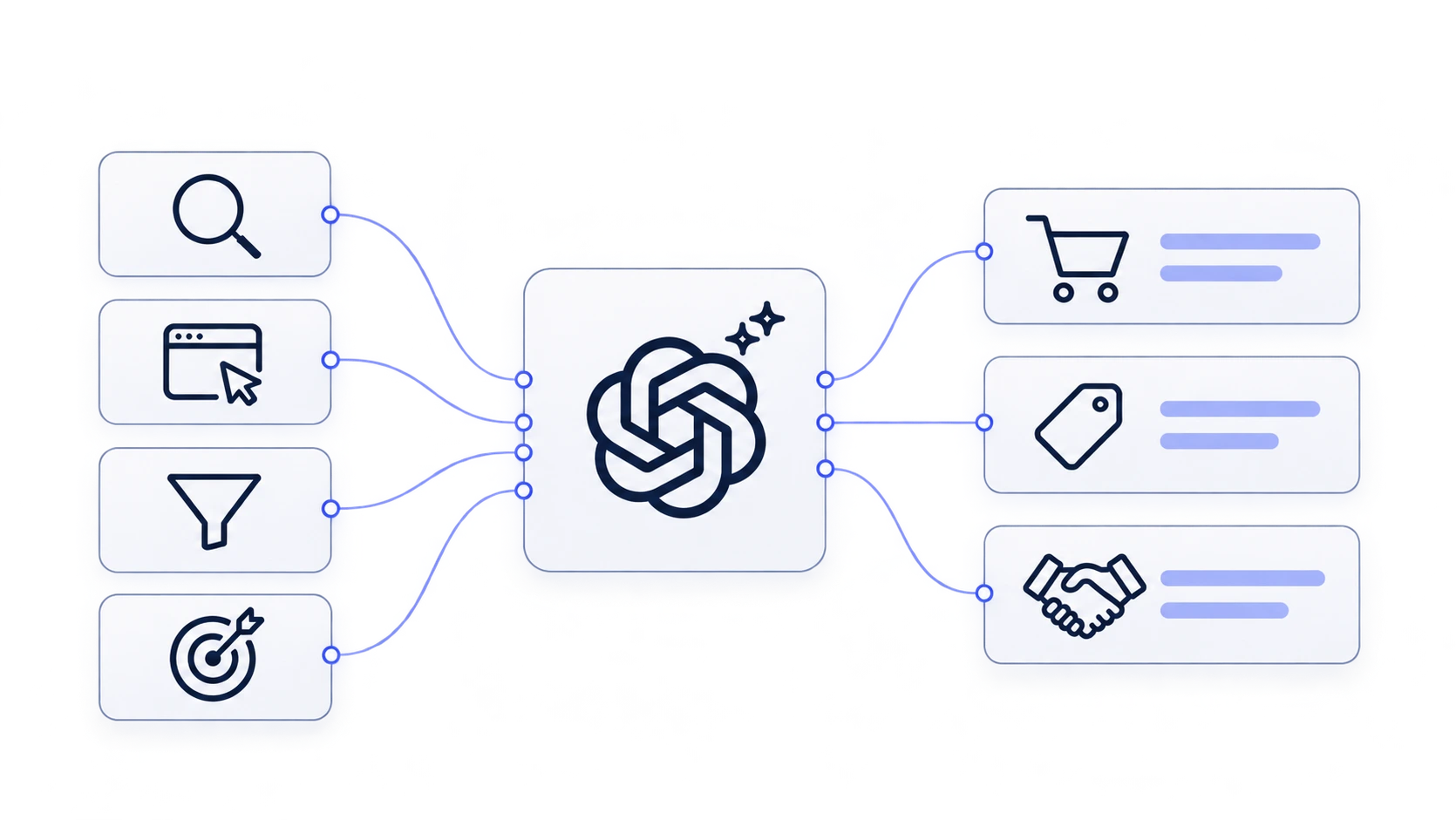
The funnel only worked because people had to search for answers. AI collapses that search into a single interaction. When the search disappears, advertising stops guiding decisions and starts fighting for relevance.
Since the early 2000s, digital advertising worked because uncertainty was distributed. Attention fractured across search results, landing pages, reviews, and retargeting loops. The funnel wasn’t theory. It was infrastructure. Marketing existed to manage indecision.
That changes the moment an AI assistant becomes the place where intent is both expressed and resolved. The journey collapses. Users aren’t asking to be sent somewhere anymore. They’re asking for help. And when the assistant can answer confidently or complete the action itself, the process ends where it begins.
Open AI’s decision to delay advertising mattered, and that deliberate strategy that allowed the product to act as an authority rather than a media play. They where shaping new behaviors adoption with noise to earn trust. Once that trust exists, monetization no longer looks like an interruption for end user. When AI platforms eventually monetize through advertising, I don’t think the ad will sit next to content. It will sit inside the recommendation itself.
I see that as the breaking point for the traditional funnel. Awareness and retargeting only exist because indecision takes time. If uncertainty is resolved inside a single conversational moment, repetition stops working. Exposure becomes irrelevant and trust becomes the deciding factor.
This brings up a question: when advertising enters this environment, will it feel advertorial? Will it simply be native ads rewritten for AI? Early on, I think the answer is yes. AI advertising will feel advertorial because that’s the least disruptive way to introduce monetization without breaking trust. The assistant will disclose sponsorship and frame recommendations carefully. Instead of telling users what to do, it will simply present options and explain its rationale.
In that phase, AI ads will resemble native ads for a simple reason: native advertising was the first serious attempt to blend promotion into the experience rather than interrupt it. But that’s also where the similarity ends. Native ads still sit beside content. AI ads sit inside judgment. Once users acclimate, the advertorial feel will fade. The assistant stops sounding like it’s “suggesting” and starts sounding like it’s deciding. It’s no longer saying, “you may want to consider this brand.” It’s saying, “this is the option that fits what you asked for.”
At that point, the experience stops feeling like advertising altogether. It feels like hiring a smart assistant who occasionally has preferred vendors. That distinction matters because users don’t actually hate bias. They hate wasted time. People accept biased recommendations every day from doctors or financial advisors, as long as the outcome is good and the bias is transparent. AI just scales that dynamic.
So yes, I think initially the experience will resemble native ads. You’ll see softer phrasing and explicit sponsorship disclosures. That’s training wheels. The destination is something else entirely: commerce embedded inside reasoning. Paid influence, but constrained by user trust and long-term dependency. Once users trust that the assistant is still on their side, they won’t care whether a recommendation is sponsored. They’ll care whether it worked. That’s the moment advertising stops looking like advertising and starts looking like delegation.
The fallout from this shift is unforgiving. There are no second chances through retargeting. Either the product delivers, or it disappears. The deeper change isn’t that users move to one screen. It’s that they rely on one decision maker. The assistant becomes the filter between intent and action. Advertising doesn’t vanish in this world. It sheds everything ornamental. What remains is accountable influence constrained by performance. The funnel doesn’t evolve. It becomes unnecessary.
If you want to understand how this works, you have to reset your mental model because it completely breaks the idea of “inventory” as we’ve known it.