
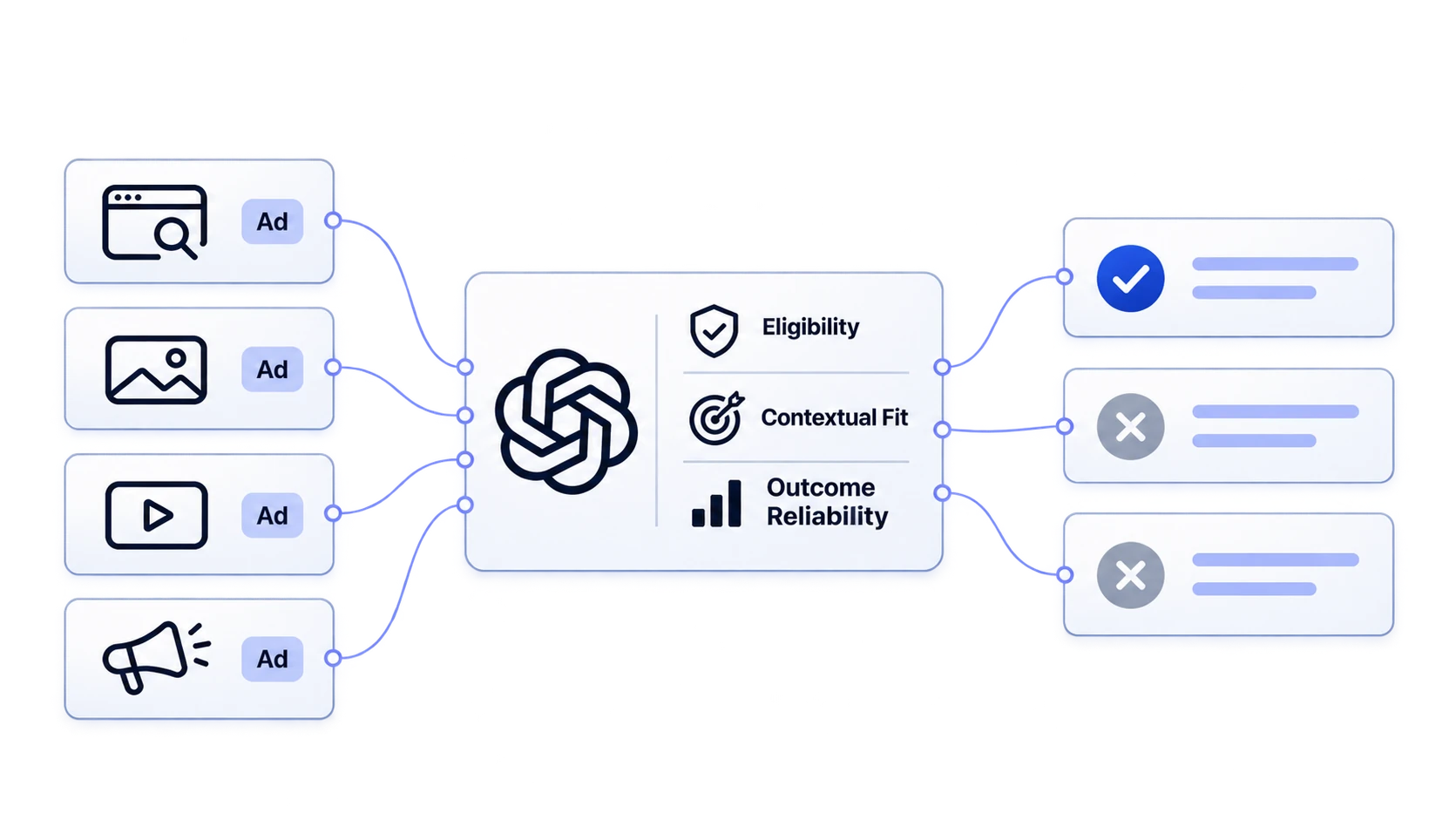
Over the last couple of weeks, I wrote two pieces about the collapse of the funnel and the economics of resolution. The argument was structural. When AI assistants settle intent in a single interaction, the traditional journey compresses. Users are no longer guided through awareness, comparison, and retargeting loops. They ask a question and receive a synthesized answer, and if that answer feels sufficient, the process ends there. That compression changes more than media mechanics. It changes how brands qualify to be chosen at all.
That shift affects monetization, but it also affects eligibility. The practical question becomes what determines whether a brand qualifies when that decision is being resolved. Once assistants mediate choice, the focus moves from traffic acquisition to qualification inside the decision layer itself.
There is increasing discussion around Answer Engine Optimization, or AEO, and Generative Engine Optimization, or GEO. Many marketers are treating them as interchangeable, not because the industry has failed to settle on terminology, but because they appear to solve the same problem. Both are positioned as ways to influence how brands show up inside LLM responses, and on the surface it is easy to assume they are simply two names for the same capability.
If I had not spent the last few years close to how these assistants evolve, I would likely see it the same way. The pitches make it sound unified. “We’ll get you placement inside ChatGPT.” “We’ll optimize you for LLMs.” That framing suggests AEO equals GEO and that either one is the path to being cited. It suggests that visibility inside an assistant is a surface to be secured rather than an outcome to be earned.
That assumption is incomplete because AEO and GEO operate at different layers, even though they reinforce one another. AEO addresses extractability. When content is clearly written, logically structured, and direct, it becomes easier for an assistant to reference. Organized explanations and clean answers increase the likelihood that your information appears when someone asks a factual question. AEO improves the odds that your content can be surfaced in informational responses, and that foundation matters.
GEO, however, operates at the entity level rather than the page level. Large language models do not evaluate a single article in isolation. They learn from patterns across the data they are trained on and updated with. They absorb how often a brand is cited, the credibility of those citations, and whether its positioning remains consistent across environments. They reflect public feedback and reinforcement from independent sources. Over time, those signals accumulate into a picture of reliability that influences whether a brand appears safe to recommend.
In a resolution-driven environment, that picture determines eligibility. If an assistant is responsible for recommending a financial product, a brokerage platform, or a service provider, its credibility depends on the quality of those recommendations. Models that repeatedly surface brands associated with regret weaken trust in the assistant itself. As a result, assistants will tend to favor brands that appear dependable based on accumulated patterns in the data.
This is why treating AEO and GEO as interchangeable creates misplaced expectations. Clean structure does not automatically create credibility, and strong brand reinforcement does not automatically guarantee surfaceability. AEO influences whether you can be cited, while GEO influences whether you can be selected. They reinforce one another, but one does not replace the other. Confusing the two leads to overconfidence in formatting and underinvestment in reputation.
It also explains why some vendor promises should be examined carefully. Large language models are not traditional media surfaces with fixed inventory. There is no guaranteed slot to purchase in the way marketers are used to. If a pitch centers on “LLM placement” without addressing both content extractability and brand-level credibility, it is presenting one lever as the whole mechanism rather than acknowledging the broader qualification logic at work.
In the two preceding articles, I argued that advertising will likely enter LLM environments inside recommendations themselves rather than as separate banners. That view does not contradict what is outlined here. It reinforces it. Even if paid inclusion becomes part of how assistants monetize, eligibility will still precede money because the assistant’s credibility remains central to its value.
There is a useful parallel in paid search. You could bid aggressively on a keyword, but your ability to compete was constrained by Quality Score. That score was not based on a single variable. It reflected expected click-through rate, ad relevance, and landing page experience. Performance signals and user experience shaped how efficiently you could buy visibility. Money alone did not guarantee exposure because the system protected itself against low-quality outcomes.
A similar economic logic is likely to apply inside LLM environments. Whether a recommendation is organic or sponsored, the assistant’s credibility remains at stake. If monetization is layered in, it cannot override the model’s need to produce reliable outcomes. Brands will still need to appear relevant, consistent, and dependable across the data LLMs learn from. The same foundations that influence organic citation will influence paid eligibility because both depend on how trustworthy the brand appears inside the model’s accumulated understanding.
It is also important to acknowledge that this environment is evolving. Large language models are continuously updated. Training data shifts, fine-tuning approaches change, and retrieval mechanisms improve. How assistants weigh sources and incorporate fresh information will continue to evolve, and the exact mechanics of recommendation will not remain static.
What is more stable is the incentive structure. If assistants are expected to resolve decisions credibly, they cannot repeatedly recommend brands that produce poor outcomes. While implementation details will shift, the direction remains consistent. Brands that appear reliable across the data these models learn from will hold an advantage over those that rely purely on surface optimization.
Some companies will misread this moment and focus narrowly on formatting. They will implement AEO tactics and assume they are optimized for AI. That work matters, but it does not address the broader requirement. If customer experience is uneven, if positioning shifts across channels, or if public sentiment trends negative, those signals accumulate. Structure alone cannot override that accumulated perception.
There is also a predictable response in spending. Brands that struggle to qualify within AI-mediated decision environments will shift capital toward channels where evaluation is less immediate. Outdoor placements, podcast sponsorships, influencer partnerships, and broader brand storytelling will continue to shape perception because they build familiarity without forcing a direct comparison at the moment of choice.
When a user ultimately asks an assistant what to choose, familiarity is filtered through credibility. The assistant must provide an answer, and that answer reflects accumulated patterns in the data rather than recent impression volume. If a brand does not meet the threshold for selection, upstream awareness does not convert into recommendation because eligibility was never established.
The funnel dissolved because AI reduced indecision and compressed the journey. What replaces it is a narrower gate in which qualification becomes the central constraint. Companies that understand this will treat customer outcomes, consistent positioning, and independent validation as part of growth infrastructure rather than as secondary concerns. Companies that focus only on extractability may gain appearances in answers, but they will struggle to win decisions in environments where assistants mediate choice.
In that context, the constraint is no longer traffic volume or impression share. The constraint is whether the LLM's have enough accumulated evidence to choose you with confidence.