
Borrowed Trust, Non-Linear Media, and the Strategic Tradeoffs of Modern Pharma Marketing
I was in the middle of watching a show on Amazon Prime when a pharmaceutical ad came on. Normally, that’s a passive moment. Background noise. Half attention at best. Then I heard the line that immediately turned my attention to the screen.
“Tardive dyskinesia is caused by certain prescription mental health medications. It’s true. So, talk to your doctor and visit theothertd.com.”
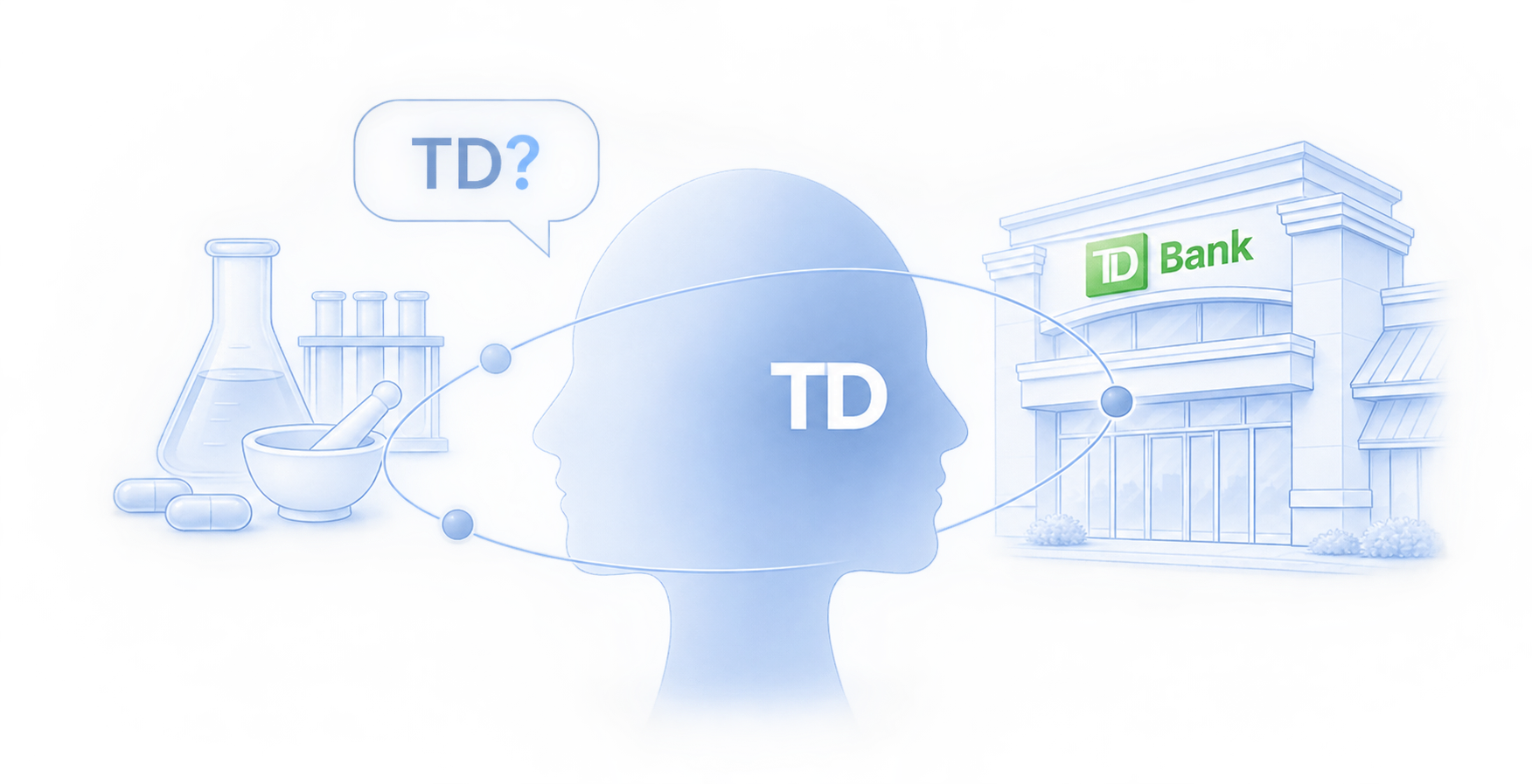
That phrase “the other TD” immediately cut through. Not because I’m especially attentive to pharma ads, but because “TD” already means something to me. And this wasn’t it. Immediately my mind goes to “what’s the other TD”?
My reaction alone tells you the campaign achieved its first objective, and that’s interrupting the viewers’ expectations. The second time the ad was served to me, I paid closer attention. I paused it, rewatched it, not because the ad spoke to a condition I suffer from, but because I recognized the campaign strategy.
What made the moment particularly interesting is that it hit me from two directions at once. I’ve worked in pharmaceutical advertising, and I currently work in financial services. Both categories depend heavily on trust, familiarity, and recognizable shorthand. So when I hear “TD,” my mind goes to the same place most Americans’ minds go: TD Bank.
The URL Isn’t Clever. It’s Strategic.
Let’s be explicit. The campaign directs viewers to TheOtherTD.com. That choice does several things at once:
It assumes “TD” already carries meaning
It introduces a competing definition without explanation
It relies on curiosity, not persuasion
Layered on top of that are deliberate creative cues, a Kelly green palette, football language, sports driven visuals, and cultural shorthand that feels mainstream and familiar. To a financial services audience, it reads as seasonal bank adjacent. To a sports audience, it reads as touchdown shorthand. This isn’t coincidence, it’s borrowed trust.
More importantly, this kind of decision doesn’t live in creative alone. It reflects a strategic alignment between Teva Pharmaceuticals and its agency partner, Razorfish Health, around what the campaign is designed to do and, just as importantly, what it is not.
The Limit of Shorthand as a Cognitive Bridge
For the strategy to effective for this particular campaign / brand, you cannot rely on just sports shorthand as a universal cognitive bridge for this category. Tardive dyskinesia is not a gender specific condition, and its audience extends well beyond sports minded viewers. Football metaphors, “TD” as touchdown, or recognition of a retired male athlete will not resolve meaning for a large portion of the population. For many viewers, particularly women, caregivers, and non-sports-oriented households, those cues either fail to register or introduce noise rather than clarity.
In mixed or non-sports audiences, institutional shorthand tends to overpower cultural shorthand. TD Bank is not a niche reference or seasonal sport. It is reinforced through daily financial behavior, physical locations, long running brand spend, and habitual use. When an acronym competes between a cultural association and an institutional one, the institutional meaning often wins, especially outside the core fan base. In those moments, interpretation defaults to the most reinforced definition available.
This reinforces a subtle but important point. The campaign did not simply rely on “TD” as a football cue, it relied on “TD” as familiar shorthand without controlling which familiarity would dominate across segments. Whether the shorthand was meant to evoke touchdowns, banking, or simple familiarity is ultimately irrelevant. Once a campaign relies on preexisting meaning rather than explanation, control over interpretation is lost and any associations that surface become a liability the brand has to own.
The Two-Track Playbook of Pharma Marketing
In pharmaceutical marketing, the launch of a new treatment typically follows a two-track playbook. First, you launch a Non-Branded (Disease State Awareness) campaign. Its goal is to condition the market by surfacing the symptoms and the condition itself, often before the drug is even mentioned. This is followed by a Branded Campaign that pivots to the specific treatment and its benefits. This sequence is designed to build a bridge from "I have this problem" to "This is the solution." In a regulated environment, this separation allows a brand to educate the public on a condition without the immediate legal and creative constraints that come with promoting a specific molecule.
Why This Works Because It’s Unbranded
This context matters. The Other TD is an unbranded disease-awareness campaign. It is not meant to build immediate product equity. It exists to surface a condition many people don’t realize exists, let alone understand as medication induced. Downstream, Teva’s branded treatment is Austedo XR, but that brand is intentionally not the hero of this moment.
Non-brand campaigns exist to condition the market before brand ever shows up. They shape language, prime recognition, and establish mental shortcuts that branded messaging later depends on. When that conditioning borrows from existing brand equity intentionally or not it accelerates awareness, but it also changes how signals travel once the brand enters the conversation.
Borrowed trust is dangerous when you’re trying to build long term brand ownership. But in a non-brand awareness context, borrowed trust functions as an accelerant. The asset being built isn’t Teva’s corporate brand or treatment. It’s the disease state itself.
The goal is not to recall a drug name. It’s recognition of symptoms and a more informed conversation with a physician later. That distinction is what makes the strategy defensible.
From Strategy to Execution: The Narrative Handoff
In a perfect execution of the pharma playbook, the transition from the unbranded "education" phase to the branded "treatment" phase should feel like a relay race where the baton is passed seamlessly. However, when the branded spot for Austedo XR was served to me, and not in a deliberate sequence, the handoff felt less like a relay and more like a complete change of venue.
The branded commercial, titled "Spouse Knows Best," pivots entirely away from the high octane stadium energy of "The Other TD". Instead of fans cheering in a living room for a touchdown, we find a couple in the quiet, mundane moments of daily life: watching TV at home, ordering coffee, and walking through a supermarket. The dialogue is intimate and clinical: “Honey, your mouth and eyes are moving again... let's go talk to your doctor”. While the ad effectively lists the benefits noting that AUSTEDO® XR (deutetrabenazine) extended-release tablets can significantly reduce TD movements, the creative used in the branded spot was a stark departure from the sports centric world of the unbranded teaser.
Where the Experience Starts to Fray
What stood out to me wasn’t sequencing. It was visual and narrative discontinuity. The unbranded campaign leans heavily into football language, sports metaphors, and collective energy. The branded Austedo XR spot, by contrast, shifts into everyday living, personal routines, and individual impact. Both approaches make sense independently. But they live in different emotional and visual worlds.
As a viewer, the connection between them wasn’t something that resonated. It was something I inferred as a marketer. My increased attention didn’t come from a clear narrative handoff. It came from recognizing the system at play. That’s an important distinction.
In a programmatic environment where sequencing can’t be guaranteed, creative continuity becomes the integration layer. That’s where the gap shows up here, sequencing is the strategy that reinforces integration, but it can’t create it. If the creative doesn’t establish continuity, linear control only masks the gap instead of closing it.
In a non-linear environment, cohesion doesn’t come from order, it generally comes from recognition. Specifically creative elements like a shared accent color, recurring motif or parallel visual language. Even one consistent semiotic cue could have created perceptual continuity without violating MLR constraints or collapsing brand roles. Right now, the integration exists strategically, but not experientially.
Why Streaming Changes Everything
Part of this disconnect is structural. In traditional linear television, sequencing was enforceable. You could bookend. You could control spot placement. You could design narrative flow across time slots. Pharma campaigns were often orchestrated deliberately in that environment. Streaming doesn’t work that way.
Most CTV inventory today is bought through programmatic, biddable systems that optimize for reach and frequency, not narrative order. Even premium placements behave more like addressable media than scheduled media.
That means:
You can target audiences, not moments
You can influence adjacency, not guarantee sequence
You can model exposure, not choreograph it
When sequence can’t be controlled, continuity has to do the work sequencing used to do. Importantly this is why shared visual language matters more now than ever. Without it, even well aligned campaigns can register as parallel rather than connected.
There’s also a structural reality in pharma that’s worth acknowledging. Non-brand and brand efforts are often developed on parallel tracks, sometimes by different teams or agencies altogether, each operating with distinct briefs, timelines, and success metrics. Even when the overarching strategy is sound, cohesion isn’t guaranteed, especially once work moves from concept to execution across fragmented, programmatic media environments.
The Path Forward: Solving for Continuity
If we accept that we can no longer control the sequence of the viewer’s journey, as marketers must change how we design the "connective tissue" between Brand and Non-Brand efforts. To solve the "frayed" experience, we need to move toward Experiential Cohesion:
Establish a "Visual North Star": Regardless of the agency or team, at least 20% of the visual assets should share a common "DNA." Whether it’s a specific cinematic lighting style or a shared graphic motif, there must be a visual anchor that survives the jump from the stadium to the living room.
The "Sonic Signature": In a world where people are often multi-tasking, audio is the strongest bridge. A shared mnemonic or even a consistent voiceover tone can create a perceptual bridge that visual shifts might break.
Intent-Driven Architecture: Having spent time inside environments where brand and non-brand efforts were executed on different tracks, I’ve seen how intent hierarchy ends up doing more work than creative cohesion. In practice, media strategy must adapt to user intent long before brand architecture catches up especially in regulated categories where education, treatment, and access are all competing for the same moments of attention.
What This Means for TD Bank
There’s also a discussion that needs to happen about the implications for TD Bank. When another category successfully borrows your shorthand, colors, and cultural meaning, it introduces short term ambiguity. Most consumers won’t confuse a financial institution with a medical condition, but some will pause, search, or ask clarifying questions.
Historically, that shows up as branded search noise. Increased activity around queries like “TD,” “TD commercial,” or “TD ad” is a predictable byproduct. During those moments, increased branded paid search coverage and strong SEO ownership are rational, defensive responses.
The Addition of the AI layer.
As AI assistants increasingly mediate how people ask and answer questions, ambiguous acronyms become more vulnerable to semantic drift. These systems synthesize meaning based on recency and context, not just historical dominance.
During a high reach campaign window, that can temporarily influence how “TD” is interpreted in AI generated summaries or responses. The risk isn’t lasting confusion. It’s momentary friction. For a brand as established as TD Bank, the answer isn’t alarm. It’s reinforcement. Clear brand context and continued authority across owned and third-party sources ensure both humans and machines resolve meaning correctly.
When you have a trusted legacy brand, your shorthand becomes valuable, and it gets borrowed.
Why This Campaign Is Worth Studying at an Executive Level
The most interesting thing about The Other TD isn’t the URL, the color palette, or even the cleverness of the acronym. It’s the willingness to accept controlled ambiguity in service of attention, while clearly understanding where the risk lives and where it doesn’t.
Pharma and financial services brands are conservative by necessity. Seeing a campaign that knowingly disrupts expectation, while respecting the constraints of a regulated category, is instructive.
This certainly wasn’t a creative gamble. It’s a strategic one, in this context, it’s a smart, temporary use of borrowed trust.