
Prediction markets aren’t replacing investing. They’re reshaping how financial platforms compete for user attention.
Prediction markets such as Polymarket and Kalshi have gained rapid traction, but most coverage still focuses on their accuracy or political implications. That framing misses the broader shift underway. These platforms are changing how retail users expect to interact with financial products, and that shift carries implications for brokerages, neobanks, and any institution that depends on engagement to drive revenue.
I’m looking at this from inside the retail investing ecosystem. My work sits close to how everyday investors discover platforms, decide whether to trust them, and ultimately stay active or disengage. I’m not evaluating prediction markets as forecasting tools or political instruments. I’m looking at their structure, their design, and the engagement loops they create, and what those mechanics are training users to expect when they interact with money. From where I sit, prediction markets don’t read as a novelty. They read as a signal.
Part of why prediction markets work is that they remove friction. Users are presented with a simple proposition, a clear outcome, and fast settlement. The experience maps cleanly to how people already process information today. Quickly. Reactively. With very little cognitive overhead. Most retail users aren’t sitting down to perform deep analysis every time they want to express a view. They want an intuitive way to act on something they already believe. Prediction markets make that easy.
It’s also hard to ignore how closely these products resemble online gaming experiences, and that resemblance strengthens their pull. Many of the design elements feel familiar to anyone who has spent time on live betting platforms: odds that move in real time, rapid resolution, interfaces that behave more like betting slips than traditional order tickets. Whether regulators ultimately classify these products as financial or gaming experiences, the user behavior they produce sits in the same behavioral space.
That tension showed up clearly in November 2025. A federal court ruling in Blue Lake Rancheria v. Kalshi affirmed CFTC jurisdiction over certain event contracts, even as a Nevada ruling the same month highlighted how unresolved the boundary still is between financial interfaces and state gaming laws. The regulatory debate continues, but the user experience is already shaping expectations.
Prediction markets give users the emotional feel of a gaming environment without presenting themselves as one. I’m not making a formal psychological claim here. I’m describing what I’m seeing. When risk, simplicity, and real-time engagement are packaged inside a regulated financial interface instead of a sportsbook, behavior changes. I’m seeing cautious investors jump in because the “betting slip” interface feels safer than a complex order book. Users don’t feel like they’re gambling, even though the mechanics often look similar. The framing makes the activity feel legitimate and low pressure, while still delivering the immediacy that appeals to people who are comfortable making fast, repeated decisions.
There’s been plenty written about the gamification of retail investing, much of it focused on the overlap between speculative trading and gambling behavior. What tends to get overlooked is how prediction markets are collapsing the boundary between the two. They’re not just making investing feel more like a game. They’re taking behaviors that lived in separate product categories and presenting them through a single, streamlined financial interface.
Retail investors and gaming-oriented users have always shared similar risk impulses, even if they expressed them in different environments. Traditional brokerages framed risk as investing, while sportsbooks framed it as gaming, even when the underlying behavior looked remarkably similar. Prediction markets remove that separation. They offer enough structure and legitimacy to satisfy investors, while delivering the speed and stimulation that feel familiar to users who already enjoy wagering-style experiences. What surfaces isn’t two unrelated audiences, but a single behavioral segment that’s always existed across both categories.
This becomes more interesting when you look at how brokerages actually make money. Long-term buy-and-hold investing isn’t the revenue engine. Activity is. Options trading, margin interest, and order routing are what create economic value for the platform. When users relocate their decision making and engagement time to prediction markets, that’s time not spent inside a brokerage. In this industry, attention almost always comes before activity.
Robinhood’s response makes that clear. The company built its own prediction market offering and now reports it as one of its fastest-growing revenue lines. That move doesn’t look like a novelty experiment. It looks like a defensive decision to protect engagement. If users can express a view faster and with less friction on a prediction market, brokers are left with a simple choice. Lose that activity or build the experience themselves. Robinhood chose to build it, and the speed at which the model scaled once embedded in a mainstream brokerage is telling.
Institutional interest is accelerating as well. In October 2025, ICE, the parent company of the NYSE, committed up to $2 billion to Polymarket and agreed to distribute its event-driven data globally. The following month, Kalshi closed a $1 billion Series E round led by Paradigm and Sequoia, valuing the exchange at $11 billion. By the fourth quarter of 2025, Kalshi reported weekly trading volumes exceeding $1 billion, representing roughly a 1,000% increase year over year, alongside a reported 600% growth in active retail users.
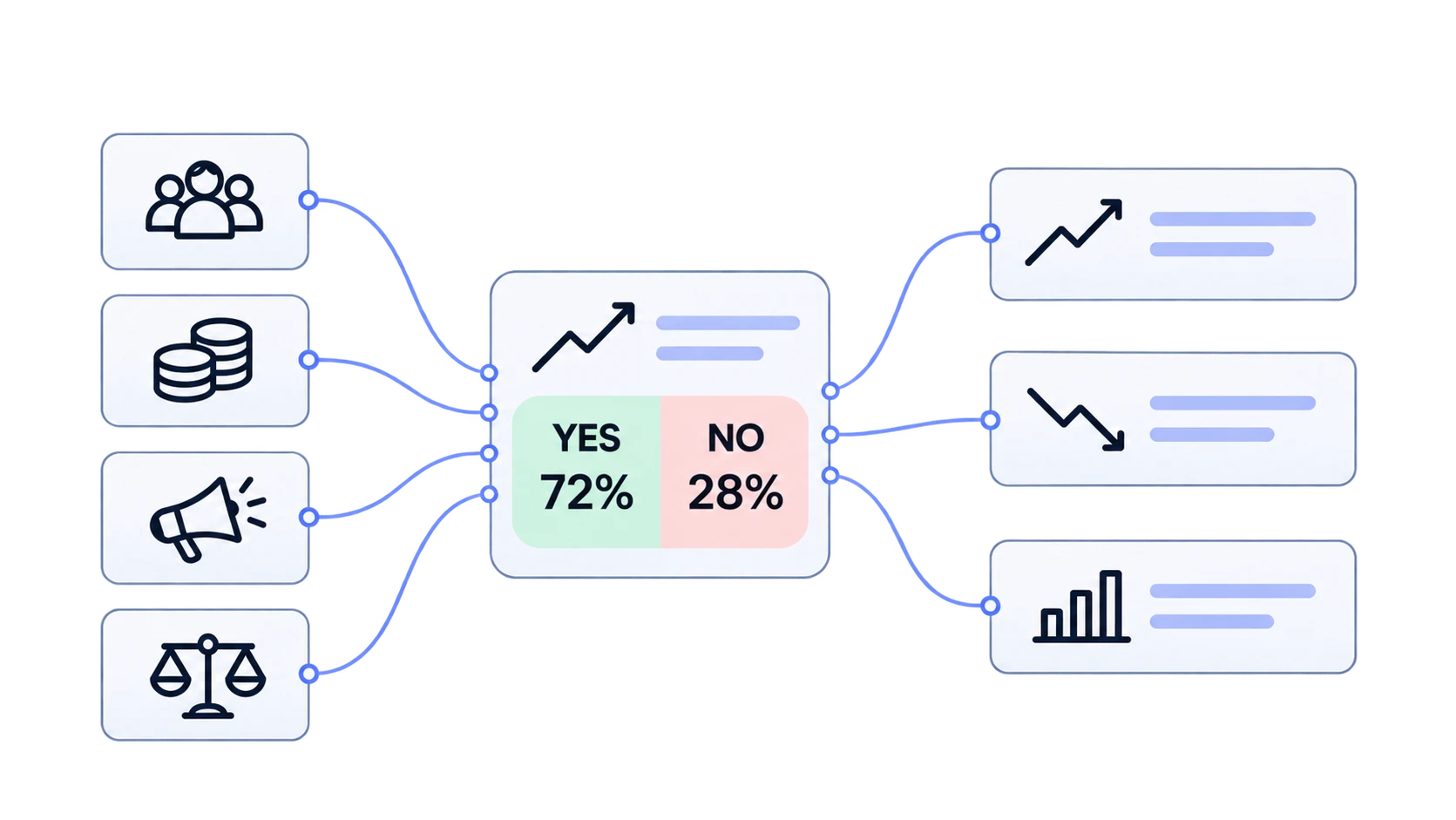
Traditional markets already react to news in real time, but acting on that information inside a brokerage still requires navigating tickers, order types, and layers of financial mechanics. Prediction markets strip that away. They let users translate an event into a simple yes-or-no decision with almost no cognitive burden. One question. No symbols. No Greeks. No order routing. Same real-world event. A very different mental load.
Prediction markets aren’t replacing traditional investing. But they are resetting expectations around how quickly and intuitively people believe they should be able to act on information. Financial institutions that dismiss this as a niche product risk misunderstanding the shift. The competition isn’t about accuracy or ideology. It’s about where users begin to form their primary relationship with money.