
For a long time now, color psychology has been the workhorse of marketing, specifically in digital marketing when we're testing the response to creative. We all learned the rules. We knew exactly which button colors drove higher click-through rates, endlessly testing red versus green or orange versus blue. We debated whether urgency or safety performed better at different funnel stages, and the big players followed suit. Think about financial institution giants like Chase or Morgan Stanley. They leaned heavily into those deep, trust-heavy blues because they needed to signal stability before a user even read a headline. It worked. It worked because digital experiences were crowded, competitive, and overwhelmingly visual. Color helped the eye make a split-second decision before the brain ever fully engaged.
As more of our daily interactions move into AI-driven chat interfaces, that environment is starting to shift, the screen itself is collapsing. One column. One dominant background. Minimal design. Often, there aren't even any visible calls to action. The visual stimulus marketers have relied on for years is being stripped away, not because design is dead, but because the interface no longer needs to compete for your attention. When you’re down to a single surface, color simply loses its leverage.
For performance marketers, this triggers a very real "Conversion Anxiety." We’re witnessing the end of what I’d call the button, the visual "CTA".
The reality is that our most reliable lever, the visual nudge, is being replaced by the Copywriter. The person crafting the prompt and the persona is now more vital to the funnel than the person choosing the hex code. Psychology isn’t disappearing; it’s just relocating.
We should be clear about where we are, though. Most companies aren't advertising entirely inside one-screen AI environments just yet. These systems are still early, evolving, and adopted unevenly. But behavior always forms before the organizational playbooks do. The pattern is already visible, even if the infrastructure is still catching up.
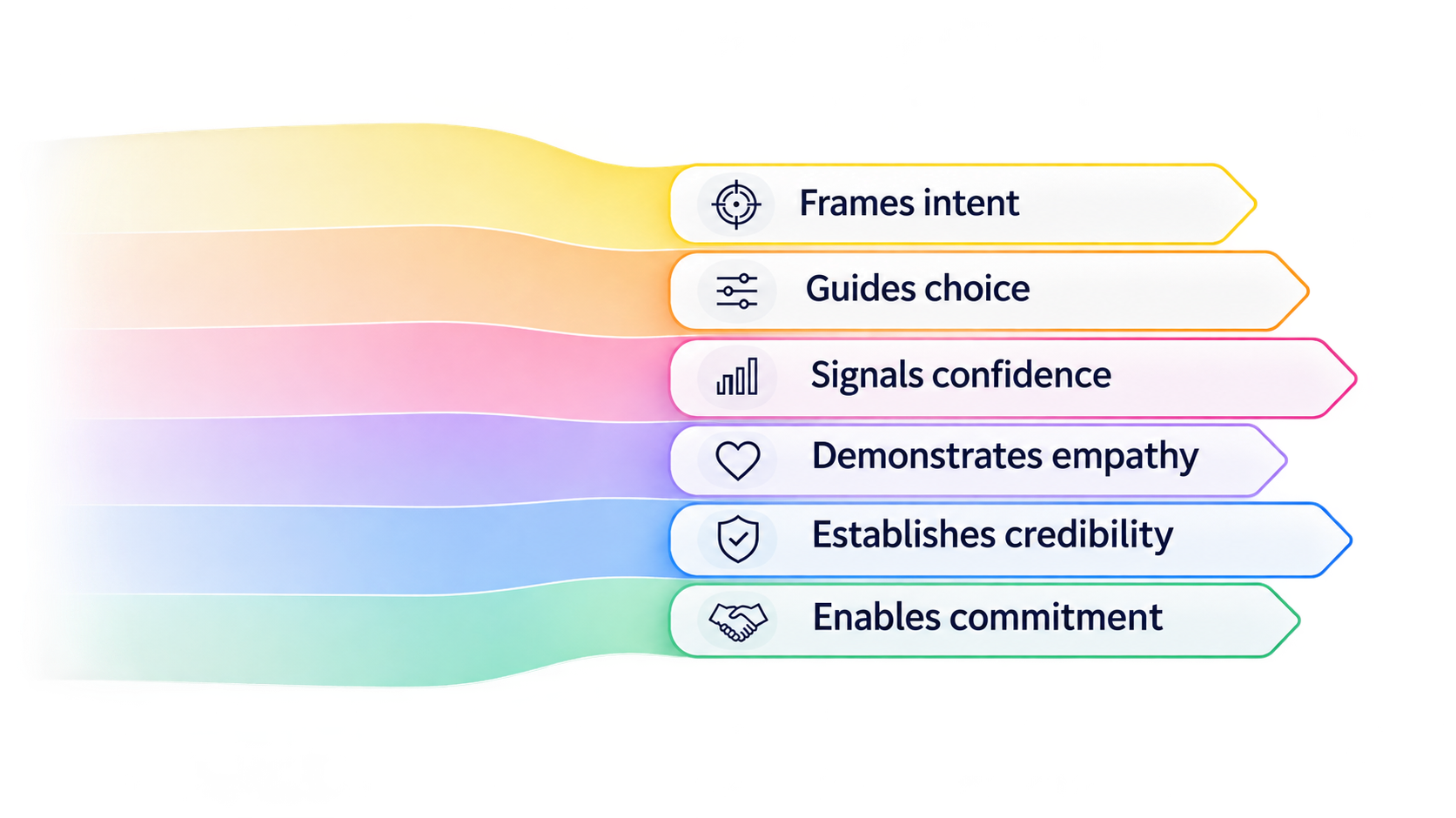
In a chat based environment, you aren't choosing what to click. You’re choosing whether to trust an answer. The moment of persuasion shifts from visual cues to linguistic ones. Tone, confidence, framing, and certainty now do the heavy lifting that color once did.
A phrase like “based on your goals” replaces that calming Chase blue. “Most people choose” introduces social proof without needing a visual badge. “High confidence recommendation” creates reassurance without a button or a badge. Even hesitation or hedging carries weight now, signaling caution rather than authority.
Now it seems as though language has become the interface. This requires a move from catching eyes to earning citations. In a visual world, we use scarcity and urgency those red banners and countdown timers. In a linguistic world, those just feel like "spam." The new strategy is about Ethos. You have to ensure your language is so authoritative and your social proof so baked into the narrative that the AI recommends you with "High Confidence" by default.
This has massive implications for brand representation. Take that financial brand built on a trust-heavy blue interface. In a traditional flow, that color reinforces safety at every step, leading toward a clearly designed CTA. But inside a chat? That brand collapses into a neutral response. The CTA no longer exists as a visual object; it’s just a recommendation sentence. If that sentence is generic or shaped by default system logic rather than brand intent, the brand’s primary signal just... vanishes. What once reassured users visually must now be carried entirely by the words used.
The greatest risk here is brand flattening. If a luxury brand and a budget competitor are both filtered through the same neutral AI interface, that brand premium evaporates instantly. The loss of that "luxury feel" isn't just a design problem; it’s a revenue problem.
Marketers have to pivot from style guides, fonts and logos, to Linguistic DNA. If your brand identity isn’t embedded in your data, the system’s default logic will strip it away. Brand teams risk invisibility if they don't own tone and narrative explicitly. Visual identity alone isn't enough anymore. If language isn't designed and governed at the brand level, you’re effectively being flattened into a system default.
That risk only grows when AI assistants or optimization layers are outsourced without brand language embedded. You get efficiency gains, sure, but you lose control. The system still speaks, but it no longer speaks as the brand. Over time, that erosion compounds.
Traditional conversion rate assumed a world of choice density where multiple elements competed for attention. Color helped resolve that. In AI environments, that collapses. There is no button to optimize. There is only the explanation, the recommendation, and the framing. The variables are now phrasing, sequencing, and restraint. The question isn't which color drives a click, but which language earns acceptance.
When users leave the chat and enter onboarding or pricing, visual identity returns as a confirmation layer. Color still matters, of course, but it comes later. It reassures them that the decision they already made cognitively aligns with something tangible. Color validates the choice; it just no longer initiates it.
This is an uncomfortable reality for many marketing orgs. The interface where persuasion happens is no longer fully owned it becomes mediated. The most influential brand interaction might actually happen before a user ever sees a logo.
This exposes a massive amount of organizational friction. We’ve always siloed "Brand" away from "Performance.” But in an AI world, the voice is the performance. We likely need something like a narrative Integrity department, where brand voice is treated as a technical asset and optimized with the same rigor we used to reserve for PPC bids.
If a brand’s voice isn't designed for AI, it will be misrepresented, or worse, represented by someone else. Marketing has always followed human behavior. The psychology hasn’t changed, but the surface has. The real question now is who owns persuasion when design steps back and language steps forward.
We’re circling back to our roots. Before the digital age, brands lived on reputation and the "voice" of the salesperson. We’re returning to that. Color and design are becoming tools for retention and validation, while language has reclaimed its throne as the primary driver of the initial sale.