
Yesterday was Super Bowl Sunday, and like clockwork, most of the marketing conversation centered on ads. Which brands won the night. Which creative landed. Which spots might carry a halo effect into the weeks ahead.
But the Super Bowl isn’t just a creative showcase. It’s an American ritual, one of the few moments each year where attention and excitement concentrate all at once. The buildup, the social gravity, the sense that this is a moment you’re supposed to care about, even if you don’t follow football the rest of the year, it creates a predictable surge in interest.
Over the last decade, that energy has been amplified by how easy it’s become to put a little something on the game. Not necessarily to gamble seriously, but to add stakes. A small amount of action turns passive viewing into participation. Participation increases excitement. Increased excitement drives demand.
Historically, that demand flowed almost entirely in one direction. When people wanted some action on the game, sportsbooks were the default outlet. Marketing strategies were built around capturing these seasonal spikes, leaning into programmatic channels, widening the top of the funnel, and accepting elevated CAC during peak moments with the expectation that LTV would justify it over time.
What’s changed is that sportsbooks like FanDuel and DraftKings are no longer the only platforms competing for that same surge in interest. Prediction markets like Polymarket and Kalshi now sit in the same attention stream, offering a different way for users to express a view, take a position, or feel invested in the outcome. The cohort hasn’t changed. The moment hasn’t changed. What’s changed is that multiple sectors are now competing for the same demand.
That’s when the Super Bowl stops being just a demand event and starts becoming a marketing stress test. While the Super Bowl creates a national spike in demand, the way that demand gets captured is deeply local. When interest rises everywhere at once, differences in CAC tolerance, payback windows, and LTV assumptions become much easier to see. The same surge can produce very different marketing outcomes depending on where users live, because taxation and cost structure determine how aggressively platforms can afford to compete for attention in each state.
New York and New Jersey provide one of the clearest examples. Around Super Bowl week, New York typically generates close to $1 billion in sports betting volume, while New Jersey lands closer to $500 million. On a monthly basis, New York often approaches $2 billion in handle, compared with roughly $1 billion in New Jersey.
That scale is why sportsbooks continue to operate aggressively in New York despite a materially harsher cost structure. Aggregate volume supports long-term LTV. From a portfolio perspective, the market still works.
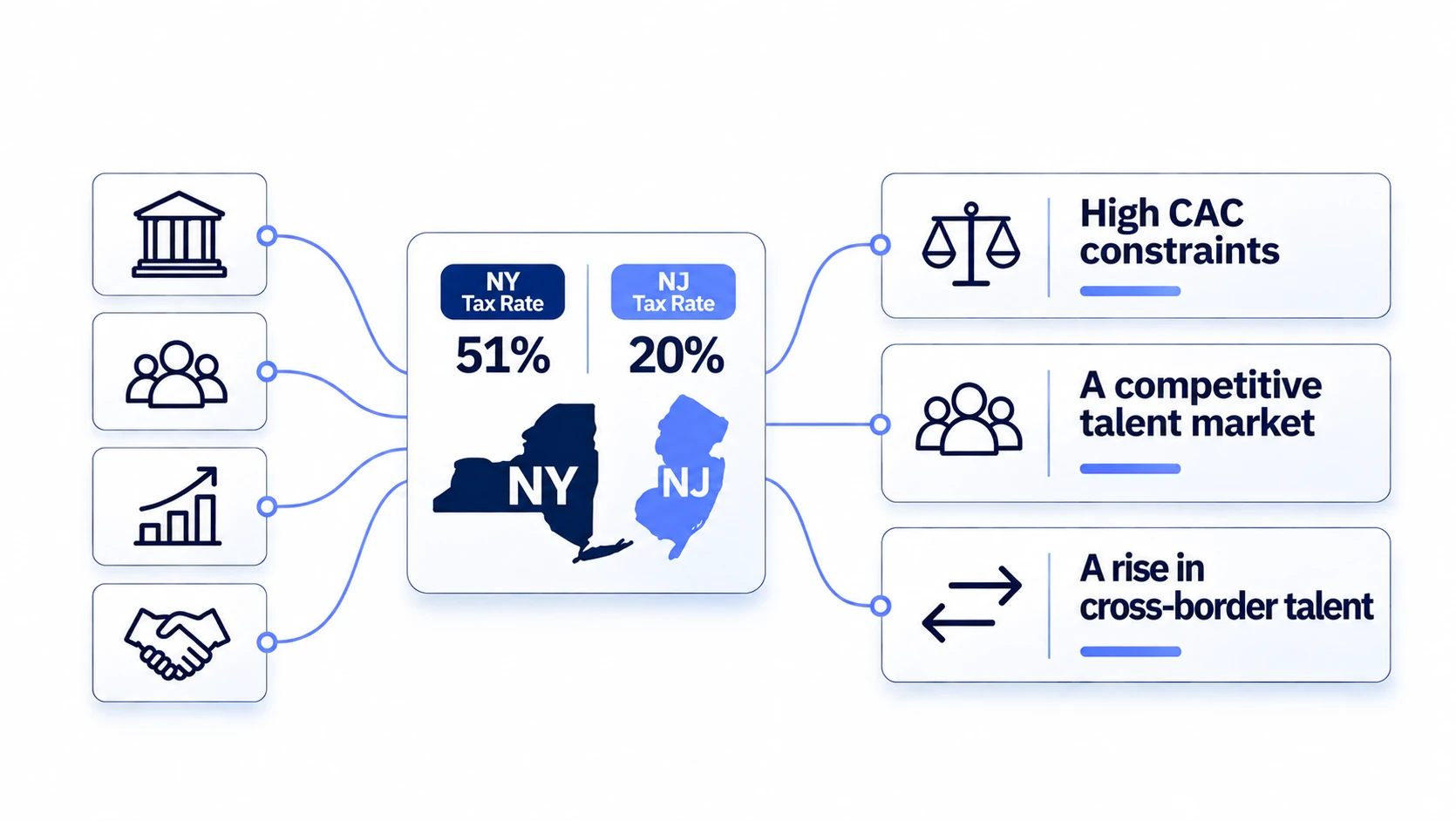
But volume alone doesn’t determine how a market gets marketed. In New York, sportsbooks are taxed at the platform level on 51 percent of gross gaming revenue, before a dollar is allocated to acquisition. In New Jersey, that platform level tax is materially lower, historically in the mid-teens and more recently closer to 20 percent. That difference doesn’t eliminate LTV in New York, but it extends the CAC payback period.
Longer payback windows change behavior. Acceptable CAC tightens. Bid ceilings come down. Marketing teams don’t stop buying inventory, but they narrow targeting, reduce tolerance for low-intent users, and concentrate spend on cohorts most likely to generate sustained engagement. Casual participation and novelty driven behavior fall below the efficiency line, not because demand disappears, but because it doesn’t amortize acquisition costs quickly enough.
Lower-tax markets allow for a looser posture. CAC can be higher relative to near-term revenue. Funnels can be broader. Promotions can run longer. Leakage at the top of the funnel is survivable because margins allow it. The same Super Bowl-driven demand exists in both states, but the acceptable CAC-to-LTV ratio differs materially.
This is where attention markets begin to reprice. Programmatic inventory clears through auctions. CPCs and CPMs are set by what the most constrained buyers are willing to pay. When sportsbooks operating under tighter economics lower bid ceilings in high-cost markets, they don’t remove demand from the system. They lower the clearing price for certain personas.
That repricing doesn’t just affect who gets acquired. It affects which channels remain viable. In markets like New York and New Jersey, channel selection becomes a constraint problem, not a creative one. These states share a single media market but operate under very different unit economics. Precision becomes mandatory.
Digital channels, paid search, paid social, programmatic display, streaming, and connected TV, continue to work because they allow state-level targeting, bid modulation, frequency control, and near-real-time optimization. Marketers can pay more for New Jersey users, cap bids for New York users, and adjust CAC thresholds dynamically as payback assumptions change.
Linear TV doesn’t offer that flexibility. Buying broadcast inventory in the New York metro means reaching New York and New Jersey simultaneously. Nielsen measures linear TV at the DMA level, not the state level, making it impossible to differentiate exposure or optimize for tax-driven economics. In a market where CAC tolerance differs materially by state, that lack of control becomes a liability.
This is why the distinction between linear TV and connected TV matters. Nielsen treats CTV and streaming separately from traditional broadcast, even though both appear on a television screen. CTV behaves like performance media. Linear TV behaves like mass reach. High constraint markets demand the former.
This channel reality reinforces the broader pattern. It’s not just that prediction markets benefit from sportsbooks pulling back. They also benefit because that pullback gives them room to train users to build habit, adaptability, and cross-engagement that extends beyond sports.
When sportsbooks are forced to prioritize efficiency overreach, they naturally deprioritize exploratory behavior. Casual participation, novelty-driven engagement, and one-off interest become harder to justify under tighter CAC and longer payback windows. Prediction markets step into that gap with a different proposition. Low friction. Simple outcomes. Fast feedback.
What starts as a way to add a little excitement to a game becomes something more subtle. Users aren’t just placing bets. They’re learning a new interaction model. One that’s intuitive, repeatable, and doesn’t require deep domain knowledge or long-term commitment.
That matters because once users are comfortable expressing a view through this format, the surface area for engagement expands. Sports may be the entry point, but it doesn’t have to be the endpoint. The same mechanics apply to politics, economics, culture, and other event driven moments. Engagement grows laterally, not because prediction markets aggressively push users elsewhere, but because the interaction itself lowers the barrier to participation.
The opportunity, then, isn’t just incremental Super Bowl volume. It’s conditioning. Prediction markets aren’t simply absorbing demand that sportsbooks choose not to chase. They’re using that window to acclimate users in markets where incumbents can no longer afford to subsidize curiosity.
This isn’t about prediction markets replacing sportsbooks. It’s about which behaviors incumbents choose not to subsidize when CAC rises faster than LTV.
High volume markets still work, but they force sharper optimization. Marketing teams protect margins by narrowing funnels and concentrating spend where payback is most predictable. The demand that falls outside those constraints doesn’t vanish. It migrates toward lower-friction experiences that don’t require heavy incentives or prolonged engagement to make the math work.
That pattern isn’t unique to sports betting. You see it anywhere margins compress and acquisition costs rise: food delivery, ridesharing, crypto exchanges, consumer fintech. When CAC increases and LTV assumptions tighten, platforms reveal what kind of engagement they actually value.
The takeaway for marketers isn’t about the Super Bowl, gaming, or prediction markets specifically. It’s about understanding that cost structure shapes CAC tolerance, and CAC tolerance shapes who gets marketed to at all. When acquisition economics change, attention redistributes. New models don’t win by being better. They win by being economical in ways incumbents can’t always afford to be.