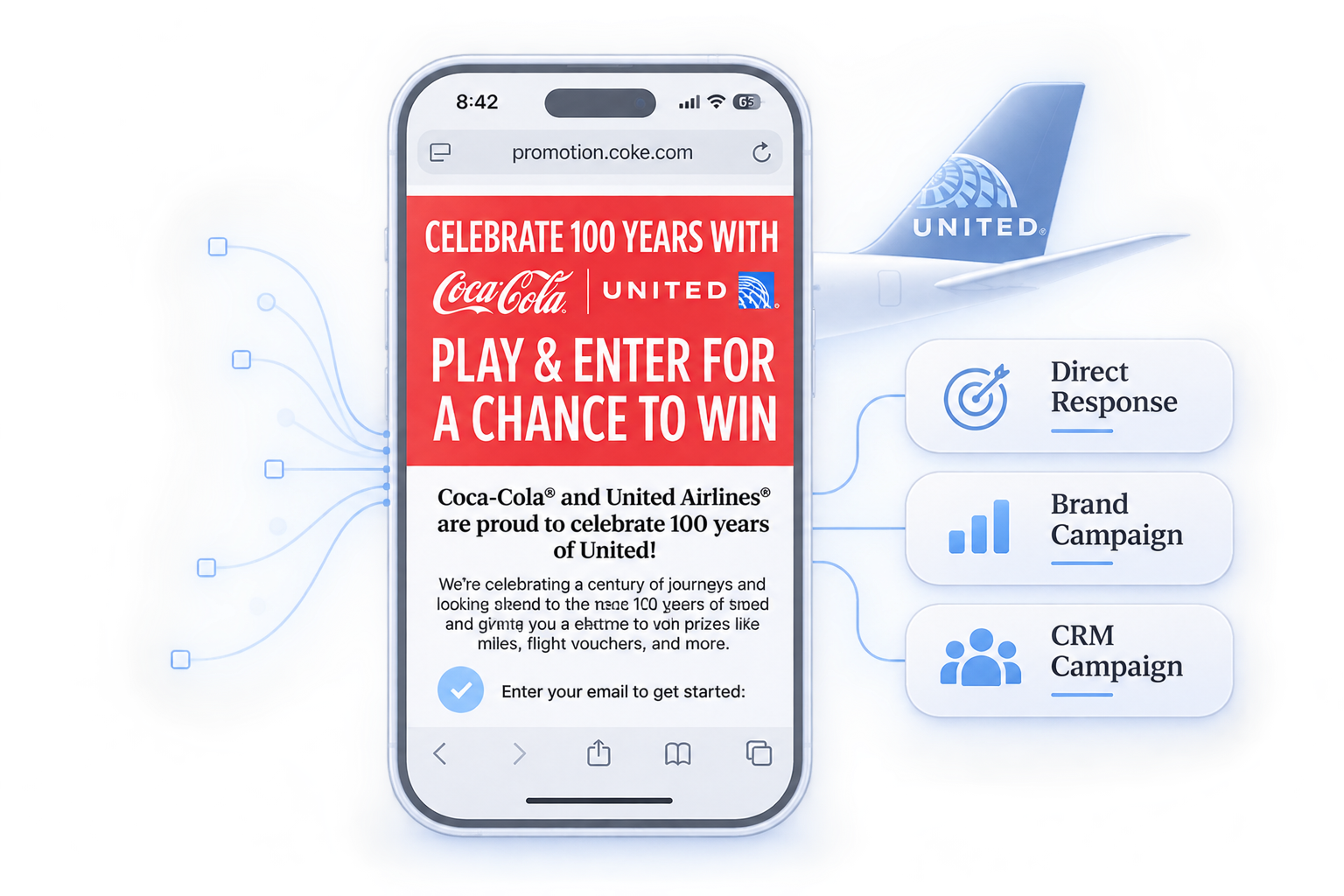
I opened the United app to check my flight to Charlotte. I wasn't looking for anything beyond my seat assignment and departure time. Instead, I got served a full-page promotion. Coca-Cola and United Airlines, celebrating 100 years together. Play a game. Enter to win. Grand visual treatment. Two of the most recognizable brands in the world, side by side, centennial energy radiating off the screen.
My first instinct as a consumer was that the prize was going to be massive. When you see Coke and United together on something presented at this scale, your brain fills in the rest. The brand equity in the room does the work for you. You assume the prize matches the presentation. You don't read the terms. Nobody does.
So I read the terms. The prize didn't match the presentation.
The total prize pool across the entire promotion was roughly $25,000. One grand prize, a round-trip United travel package valued at $6,000 at full retail fare, the kind of number that bears little resemblance to what anyone actually pays for a ticket. Four Bilt winners receiving one month of rent up to $2,500. Four Vivid Seats winners at $250 each. One Lyft credit at $1,000. One hundred Timeshifter app subscriptions worth approximately $25 apiece. That's the full payout. For a centennial campaign anchored by two global brands with a combined market presence spanning every continent.
But I wasn't looking at this as a consumer chasing a prize. I was looking at the economics. And from that lens, this promotion is one of the most efficient marketing structures I've seen in a long time because it isn't one campaign. It's three.
A direct response campaign, a brand campaign, and a CRM campaign, running simultaneously, inside a single promotion, funded by one centennial moment.
The Architecture
To understand who wins and why, you have to understand how the promotion is actually structured.
Coke is the sponsor and owns the entire entry experience. Regardless of how a participant finds the promotion, through the United app or by scanning a QR code on a specially branded Coca-Cola can served on a United flight every entrant lands on promotion.coke.com. Coke's page. Coke's form. Every name, email address, zip code, date of birth, and channel attribution answer goes into Coke's database. The Coke marketing opt-in checkbox is optional, but it sits directly in the submission flow before the submit button — a placement decision that elevates conversion well above what a standalone permission request would generate.
United is the distribution vehicle. After completing Coke's form, the entrant is directed to a secondary United page with four calls to action: sign in or join MileagePlus, opt in to United email marketing, sign up for United text messages, and link your MileagePlus and Lyft accounts. United's conversion depends entirely on how many people take that second step after completing Coke's form. It is a conversion on top of a conversion — not a guaranteed handoff.
There is no paid media in this promotion. The attribution dropdown on Coke's entry form confirms it. The options are United Flight Seatback Menu, United.com and United App, Social Media, Email, and Other. No paid display. No search. No out of home. No television. United is the entire media plan and Coke paid for access to it. The precise commercial terms between them are not public — but large public companies do not run co-promotional partnerships on a handshake. Even when the net economics between two parties approach zero, the transaction is invoiced in both directions. Each side recognizes revenue on their respective P&L. Each division is accountable to internal stakeholders. When something is free there is no standard of care. When there is a cost attached there is accountability, and accountability means consequences when things go wrong. The invoice is not just a financial instrument. It is the mechanism that creates the obligation.
Two Entry Points, Two Different Jobs
The promotion has two distinct entry paths and each one is doing a different job.
The United app serves existing MileagePlus members — people already identified, already in the ecosystem, already high value. For this audience the promotion is reinforcement. United isn't acquiring these customers. They already have them. The goal is deepening the relationship — adding permissions, linking accounts, increasing engagement — using Coke's budget and Coke's centennial narrative to do it.
The can entry is a different job entirely. Specially branded Coca-Cola Original Taste and Coke Zero Sugar cans are distributed exclusively on United flights and in United Club locations throughout April. The QR code printed on the side drives directly to promotion.coke.com. Not every passenger on a United flight is a MileagePlus member. Corporate travelers booked through third parties, occasional flyers, guests — they are in the United environment but not in the United database. The can reaches them where the app cannot.
And because the can entry requires a Coca-Cola account login, every scan that converts creates or reactivates a first-party Coke identity. A Coca-Cola account is a richer asset than an email opt-in. It is a persistent identity Coke owns and can activate across future campaigns. That is Coke's acquisition play — not retail, not mass market, but captive and premium, inside the cabin.
One constraint worth acknowledging: not every passenger orders a Coke. The promotion is limited to two specific products. Sprite drinkers, water drinkers, and everyone else are outside the funnel. The can reach is a subset of total passengers, not the full flight manifest. That is a real limitation and the article would lose credibility by ignoring it.
The Four Entry Periods
The official rules confirm four distinct weekly entry periods across April: April 1–7, April 8–14, April 15–21, and April 22–30. Each period has its own drawing. All entries also accumulate into an overall Grand Prize drawing and an overall First Prize drawing at the end of the month.
This structure is not administrative. It is behavioral.
The first entry creates commitment. You have filled out the form. You are in the system. You want to maximize your chances. The psychology of that initial investment pulls you back the following week, and the week after that. Each return visit is another brand impression for Coke, another engagement moment for United, and another opportunity to convert on the secondary United CTAs that didn't land the first time around.
The person most likely to enter a sweepstakes is by definition responsive to promotional incentives. The four-period structure is designed specifically for that person. It costs nothing to implement once the infrastructure is built. You open four windows instead of one and let commitment bias close the gap.
The Scale
MileagePlus has over 130 million total members globally. That is almost certainly the number used to sell this partnership. But this promotion ran for April only. Monthly active users on the United app, based on industry norms for large airline loyalty programs, realistically sits between 2.5 million and 7.5 million in any given month. These are not passive names on a list. These are frequent travelers actively managing flights, miles, and bookings. High income. High intent. Already in the app with a purpose.
On the can side, United operates over 4,500 flights per day. Across 30 days in April, millions of branded cans move through the cabin. The reach is significant — but filtered to passengers who specifically order one of the two promoted products.
The realistic addressable audience across both entry points is in the millions. All premium. None reached through paid media.
What Each Party Actually Got
Coke got brand presence inside a closed, premium, captive environment with a performance layer attached. First-party data records on high-income travelers. Coca-Cola account creation at scale. Channel attribution intelligence on every single entry. And a centennial co-brand narrative alongside one of America's most iconic airlines, distributed through that airline's owned channels at the moment passengers are most engaged with the brand.
What Coke cannot measure from this promotion alone is brand lift. The audience subset, while valuable, is too small relative to Coke's global footprint to move a brand metric in isolation. Purchase intent, retail influence, long-term equity shift — those are real objectives but this promotion is a contributing touchpoint in a much larger brand system. The measurable return is in the data. The brand return is a byproduct of the centennial, not something this promotion can claim credit for independently.
United got their CRM enriched at a partner's expense. Email permissions, SMS permissions, and Lyft account linkages added to an existing customer base — all funded by Coke's centennial investment and driven by Coke's entry form. United's four post-form calls to action are the only ones on the page after submission. No other partner gets a post-conversion action. United owns that layer entirely and everything it produces.
The smaller partners — Lyft, Bilt, Vivid Seats, Timeshifter — received logo placement inside a Coke and United co-branded centennial campaign, served to millions of premium travelers in a closed environment their own media budgets could not efficiently access. Their collective prize liability was under $15,000. The brand fit is deliberate. United's traveler is Lyft's rider, Bilt's renter, Vivid Seats' ticket buyer, and Timeshifter's jet-lagged frequent flyer. What each paid for the placement is not public. But the audience quality is the audience each of them is trying to reach independently — and this gave them access to it at a fraction of what it would cost to find them anywhere else.
The Consumer
Most people who encountered this promotion did not read the terms. They saw Coke and United together at centennial scale and assumed the prize matched the brand equity in the room. That assumption is the mechanism. The brands never misrepresented anything. The legal copy is there. But the design of the promotion — the visual scale, the partnership gravitas, the weight of a 100-year milestone — does the work of inflating perceived value before anyone clicks submit.
This promotion works because consumer expectation is intentionally misaligned with actual payout. That's not deception. That's design.
The prize is in the terms. The brand is front and center. That gap is not an oversight. It is the architecture. And the only person who ever experiences the gap between perceived and actual value is the winner — who by that point has already submitted the form, already opted in, and already given Coke everything they came for.
The Takeaway
I found this promotion while checking a flight. I wasn't looking for a case study. But what I found is a clean, observable example of how sophisticated brands structure co-promotional economics — who owns the entry, who owns the data, who distributes, who enriches their CRM, who gets the placement, and what the consumer actually receives versus what they perceive they're getting.
Most marketing analysis covers creative decisions or brand strategy. Very little of it pulls the prize pool, maps the data flow, separates the entry mechanics by job, and shows who actually wins and why. That analysis is what's missing from most discussions about promotional marketing — and it's the analysis every brand running or considering a co-promotional structure should be doing before they sign anything.
Coke got a centennial brand moment, a first-party data asset, and a performance layer inside a premium closed environment. United got their CRM enriched on a partner's budget. The smaller brands got placement they couldn't buy independently. The consumer got a lottery ticket wrapped in 100 years of brand equity.
The juice was real. It just wasn't flowing toward the person holding the can.
This is the shift in modern marketing that campaigns like this make visible. It is no longer about awareness. It is about identity. Who you are, what you consent to, what accounts you link, what channels you open. The prize is the pretext. The data is the product. And the most sophisticated campaigns are the ones where the consumer never notices the difference.