
Sunday morning, March 15th. I was not planning to write an article today.
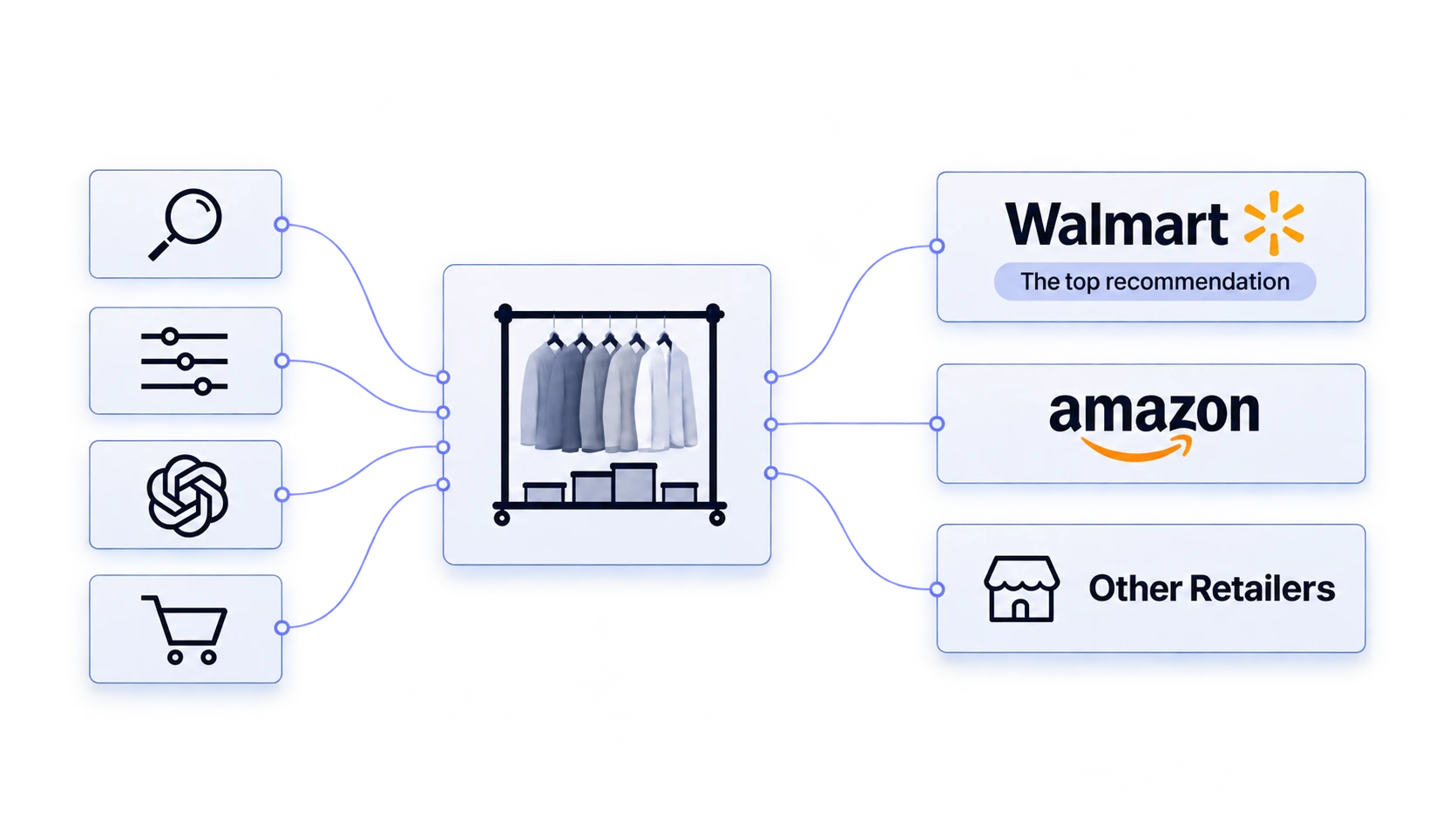
I was looking for a clothing rack. Something simple for extra storage, the kind of purchase that normally takes ten minutes: search, compare a few options, and order one. Instead of opening a dozen retailer tabs, I did what a growing number of people now do. I asked ChatGPT for recommendations.
What happened next made me stop what I was doing. Every recommendation the assistant produced pointed to Walmart.
Not Amazon. Not specialty retailers. Not furniture brands. Walmart. At first, I assumed it was coincidence. Then I asked for similar options. Again, Walmart. I tried variations of the question, changed the constraints, asked for alternatives, asked for similar racks with higher weight capacity. The pattern remained. Nearly every cited product source pointed back to Walmart listings.
The moment was strange enough that I stopped searching for racks entirely and started examining the results instead. What began as a simple purchase turned into something else. A small experiment revealing a structural shift in how product discovery is beginning to work.
Three weeks ago, I published an article titled "The End of the Funnel: The Architecture of Eligibility." In that piece, I argued that the marketing funnel is collapsing into a single interface layer. Discovery, comparison, and evaluation are no longer happening across dozens of websites and search results. Increasingly, they happen inside one interface where an LLM synthesizes information and produces an answer. In that environment, the question for brands is no longer simply whether they exist online. The question is whether they are eligible to appear in the answer itself.
What I observed this morning is the practical version of that theory.
Why LLMs Don't Browse Like People
LLMs do not browse the web the way people do. They do not care who dominates transaction volume. They do not prioritize the retailers with the largest advertising budgets or the most recognizable brand names. They prioritize sources they can read, verify, and cite with confidence.
In other words, they prioritize machine-readable truth.
When an AI assistant recommends a product, it needs to confirm specific attributes. Height. Width. Weight capacity. Materials. Assembly requirements. These are not marketing descriptions. They are factual specifications. If those attributes appear in clear, structured fields that an LLM can parse reliably, the page becomes a trustworthy source. If the information is buried in images, scattered across inconsistent bullet lists, or hidden inside marketing copy, the AI assistant simply moves on.
The difference may sound technical, but the consequences are enormous. Many Walmart product pages expose specifications in structured tables with predictable labels. Dimensions are clearly listed. Load capacity appears in explicit fields. Materials and construction details are presented in a format that AI assistants can easily extract. From the perspective of an LLM trying to answer a product question, that clarity makes the page reliable.
Other large marketplaces often contain the same products but present the information less consistently. Specifications may appear in graphics, promotional descriptions, or inconsistent seller-provided formats. Some platforms also restrict automated access to their pages as part of broader anti-scraping strategies. The information exists, but not in a way that LLMs can easily interpret.
The result is simple. When the AI assistant needs to cite a product recommendation, it references the source that exposes the data most clearly. It is not choosing Walmart because Walmart sells more clothing racks. It is choosing Walmart because Walmart exposes the data more clearly.
The Data Advantage Walmart Built
But Walmart's visibility in those recommendations is not just about machine-readable product pages. It also reflects something happening at the marketplace level.
While Amazon still dominates U.S. e-commerce by total volume, Walmart has quietly become the fastest-growing major marketplace in the country. The size gap between the two companies remains enormous, but the growth velocity tells a different story.
Walmart's U.S. e-commerce business has been expanding at roughly 27 percent year-over-year, compared with Amazon's 9 to 11 percent growth in the same period. The marketplace itself has also accelerated rapidly. Walmart surpassed 200,000 active third-party sellers in 2025, adding more than 44,000 sellers in just the first five months of that year alone. Today, roughly 95 percent of the products listed on Walmart.com come from third-party sellers, dramatically expanding the catalog available to shoppers.
For the first time, Walmart's e-commerce operation also turned profitable across every quarter of 2025, removing the long-standing perception that its digital strategy was a loss-leader designed primarily to support store traffic.
This growth is being fueled by advantages Amazon cannot easily replicate. Walmart's physical footprint gives it a powerful omnichannel network. Nearly 90 percent of the U.S. population lives within ten miles of a Walmart, allowing stores to function as micro-fulfillment centers capable of supporting rapid delivery windows that remain difficult for Amazon to match in suburban and rural markets. Walmart has also become the leader in online grocery, holding roughly 32 percent market share compared with Amazon's 22 percent.
At the same time, Walmart has been building a rapidly expanding advertising ecosystem through Walmart Connect, where sellers often see stronger return on ad spend because the platform remains far less saturated than Amazon's marketplace.
Seen through that lens, the clothing rack experiment begins to make more sense. Walmart is not simply appearing in AI recommendations because its pages are easier for AI assistants to read. It is appearing because the company has spent the last several years aggressively expanding its marketplace, inventory, and digital infrastructure. The result is a platform that is simultaneously growing faster, exposing product data more clearly, and allowing external AI assistants to access that information more easily. That combination makes Walmart unusually visible in the emerging AI discovery layer.
The Wall Amazon Built
But the story behind Amazon sitting behind a wall is not just metaphorical. As of March 2026, it is quite literally a technical strategy and an escalating legal battle.
Amazon is actively building barriers that prevent third-party AI assistants from accessing its product pages.
On March 4, 2026, Amazon implemented a new Business Solutions Agreement that developers are already referring to as a kill switch. Under this policy, any automated AI agent accessing Amazon must clearly identify itself, and Amazon reserves the right to demand that the agent immediately stop accessing its site. If the agent cannot comply with that shutdown command instantly, access can be terminated entirely. For independent assistants that are not formally partnered with Amazon, this effectively places a gate at the front door.
Behind that policy sits a much deeper anti-scraping architecture. Amazon has deployed what developers describe as a six-layer AI-powered defense framework designed specifically to detect and block automated agents. These mechanisms analyze not only IP behavior but also behavioral biometrics, including patterns such as mouse movement, scrolling behavior, and click timing. Amazon is no longer simply detecting bots. It is detecting anything that does not behave exactly like a human browsing session.
The practical outcome is striking. Unless an AI assistant has a formal partnership with Amazon, its ability to consistently access and interpret Amazon product pages is extremely limited. Developers estimate that the success rate of AI agents reaching and reading those pages may be as low as two percent.
On March 13, 2026, a federal court granted Amazon a temporary injunction against Perplexity AI, preventing the company's AI agents from accessing sections of Amazon's site that the company classified as password-protected. The case highlights the legal dimension of the same technical conflict: whether independent AI assistants are allowed to access and synthesize product information from closed ecosystems.
At the same time, the competitive landscape is moving in the opposite direction. Walmart has been leaning into an open AI strategy, making its structured product data easier to access and parse by external AI assistants. The difference is not about who sells more racks. It is about who makes their product data visible to the AI assistants now mediating discovery.
The New Digital Shelf
For two decades, e-commerce discovery revolved around search results. Consumers typed queries into search engines, scanned lists of links, opened multiple tabs, and gradually narrowed their choices. Retailers competed for position in those results through advertising, SEO, and marketplace visibility.
AI assistants compress that entire process into a single interaction. A user asks a question. The LLM synthesizes available information. A handful of recommendations appear. That is the entire funnel.
There is no second page of results. No endless scrolling. No casual browsing across dozens of retailers. The answer itself becomes the discovery layer. If a product appears inside that answer, it occupies the digital equivalent of eye-level shelf placement in a store. If it does not, it effectively does not exist.
The experiment with the clothing rack exposed how brutally selective that environment can be. The AI assistant did not surface ten retailers competing for attention. It surfaced a small set of products sourced from pages it could parse confidently. Everything else disappeared from view.
Eligibility replaces ranking. You are either inside the answer, or you are not.
What Most Companies Are Missing
Most companies are not thinking about this yet. Product pages are still designed primarily for human browsing rather than machine interpretation. Marketing descriptions dominate the layout. Specifications appear inconsistently. Critical attributes may be hidden in images or graphics. Structured schema markup is often incomplete or missing entirely.
To a human shopper, these differences may seem minor. To an LLM that is responsible for synthesizing product information, they are decisive.
The brands whose products live on those pages face the same problem from a different angle. A brand selling through both Amazon and Walmart right now is being treated completely differently by AI assistants — not because of the product, not because of the price, not because of the brand name, but because of how the data describing that product is structured and accessible on each platform.
The brand has no control over Amazon's wall. But it has complete control over how it structures its own product data wherever it does have access. Schema markup, structured specification tables, consistent attribute labeling — these are not technical details. They are the new prerequisites for visibility in an AI-mediated discovery environment.
The Citation Is the New Shelf Space
What happened on my Sunday morning clothing rack search illustrates how quickly this dynamic can shape discovery. The products that appeared were not necessarily unique to Walmart. Many of them are sold across multiple marketplaces by the same manufacturers with identical specifications. The difference was not the product itself. The difference was the accessibility of the data describing it.
The retailer that exposes product information clearly becomes the retailer that the AI assistant cites. In the emerging interface layer of AI-driven discovery, that citation is the new shelf space.
The discovery funnel hasn't just changed. It has moved. The brands and retailers still designing for human eyes over machine readability will not just find the new digital shelf hard to reach. They will find themselves invisible on it entirely.