
O'Reilly didn't invent a new product. They invented a new customer acquisition moment.
I was watching TV on a Saturday afternoon when the commercial came on. Thirty seconds. One driver. One voiceover. One problem, one solution, one call to action. O'Reilly Auto Parts offering a free check engine scan. Walk in, plug in, get answers. No appointment, no labor cost, no commitment. The ad was as frictionless as the offer itself. That alignment is not accidental. When the creative feels as simple as the experience, the barrier to acting collapses before the customer even realizes they've made a decision.
Most people watching that commercial saw a helpful service. What O'Reilly built was a value proposition designed to do one thing: own the moment before the mechanic does.
The Moment They Went After
One in five cars on the road right now has a check engine light illuminated. Roughly 38 percent of drivers admit to ignoring one over the past year. That is not a niche problem. That is a massive, perpetually replenishing pool of unresolved demand sitting in driveways and parking lots across the country, people who know something is wrong, don't know what it is, and haven't acted yet.
That moment of uncertainty is the highest-leverage point in the entire automotive repair journey. The customer is not browsing. They are not comparing. They are trying to solve a problem they don't understand, and they will follow whoever removes that uncertainty first.
O'Reilly stepped directly into that moment with a zero-friction offer. Free. No appointment. No commitment. Six thousand five hundred locations means the offer is never far away. The light comes on and O'Reilly is already there. The commercial does one job; it removes the last excuse not to go.
The Value Prop Is the Moat
O'Reilly didn't just offer a free scan. They built a proprietary product around it. The service is called Veriscan, and it draws on a database of over 650 million vehicle scans verified by ASE-certified master technicians. That number is not a marketing footnote. It is a structural moat. No independent mechanic, no regional chain, and no competing retailer can match that data set. When the consumer trusts the Veriscan report, they are not trusting O'Reilly the retailer. They are trusting a system that has processed more automotive diagnostic data than any individual mechanic will encounter in a lifetime. That trust is the asset. The parts transaction that follows is the conversion.
Once the issue is identified, the customer's decision space collapses. They are no longer asking what is wrong with the car. They are asking what to do about it. The part is known, and in many cases, it is already in stock within arm's reach. The transition from diagnosis to transaction happens inside the same environment, often within minutes. A clear trigger, an immediate solution, and a built-in conversion path that relies on timing and proximity rather than persuasion. The path has already been simplified to the point where action is the easiest option.
In the traditional repair model, mechanics derive a meaningful portion of their revenue from the parts markup, sourcing a component at wholesale and billing it at retail. When a customer arrives at O'Reilly, receives a Veriscan diagnosis, and purchases the part before a mechanic is ever involved, that markup disappears from the shop floor entirely. The mechanic receives a customer who already owns the part and is paying only for installation. O'Reilly hasn't just captured the customer. In those transactions, they've captured the margin that traditionally belonged to the shop.
Why 2020 Changed Everything
The question was whether this strategy translated into measurable business growth. A compelling offer is one thing. Demonstrating its potential commercial impact is another. But when I started examining O'Reilly's financial performance, the numbers didn't tell a straightforward story. The pandemic had fundamentally altered the economics of vehicle ownership, making it necessary to separate broader market conditions from any potential lift associated with the campaign.
To understand the impact of Veriscan, you have to understand the market it launched into. In 2020, American automotive economics shifted structurally. Used car prices spiked 27 percent in a single year, peaking at 40 to 50 percent above pre-COVID levels. By late 2021, used cars were 42 percent more expensive than 2019. New car prices climbed 16 percent between 2020 and 2022 and remained 20 percent higher than pre-COVID levels into 2024.
The result: people who would have replaced a troubled vehicle instead repaired it. A $300 repair that once competed against a $15,000 used car now competed against a $25,000 one. Repair won. Demand for parts surged not because people were driving more, they weren't, but because replacing a vehicle became financially irrational for millions of Americans. O'Reilly's addressable market expanded dramatically because the exit option got priced out of reach. Veriscan launched directly into that environment.
The Growth Story
O'Reilly is a public company. The numbers tell a clear story when read in the right sequence.
In the two years before Veriscan, 2018 and 2019, O'Reilly grew revenue at an average of 8.9 percent annually. Store count grew at a consistent 3 to 4 percent per year. Steady, predictable expansion.
2020 is the anomaly and needs to be read as one. Revenue jumped 15.5 percent that year not because O'Reilly did anything different, but because used car prices spiked and repair demand surged as a direct consequence. External market shock, not operational performance.
Remove 2020 from the baseline. In the three years after Veriscan launched, 2021, 2022, and 2023, O'Reilly averaged 10.8 percent annual revenue growth. Store count growth remained exactly what it had always been: 3 to 4 percent per year. No accelerated expansion. No major format change. No new product category. The store opening pace didn't change. The revenue growth rate did.
Comparable-store sales tell another part of the story. O'Reilly reported comparable-store growth of 4.0 percent in 2019, followed by 10.9 percent in 2020, 13.3 percent in 2021, 6.4 percent in 2022, and 7.9 percent in 2023. Existing stores were generating more revenue, not simply benefiting from the company's continued geographic expansion. That doesn't isolate the effect of Veriscan, but it reinforces the need to examine operating performance alongside store count and broader market conditions.
Against that backdrop, Veriscan introduced another potential driver of customer acquisition and revenue growth without requiring an accelerated pace of store expansion. The timing is worth examining, particularly alongside stronger comparable-store performance. That doesn't establish causation. It establishes a correlation that deserves consideration within the broader economic and competitive environment.
The remaining question is how much of that performance was specific to O'Reilly. AutoZone, Advance Auto Parts, and other aftermarket retailers operated against many of the same economic conditions. Comparing their results could help distinguish industry-wide growth from company-specific outperformance. Even then, a performance advantage wouldn't establish how much revenue the diagnostic campaign generated. Without campaign-level conversion data, the precise contribution remains difficult to isolate. What the financial results provide is context for evaluating whether the strategy coincided with stronger business performance.
The Referral Nobody Talks About
The commercial ends with a line that sounds like a courtesy: "If you don't want to do the repair yourself, we can recommend a shop for you."
It's not simply a courtesy. It's the other side of O'Reilly's business model.
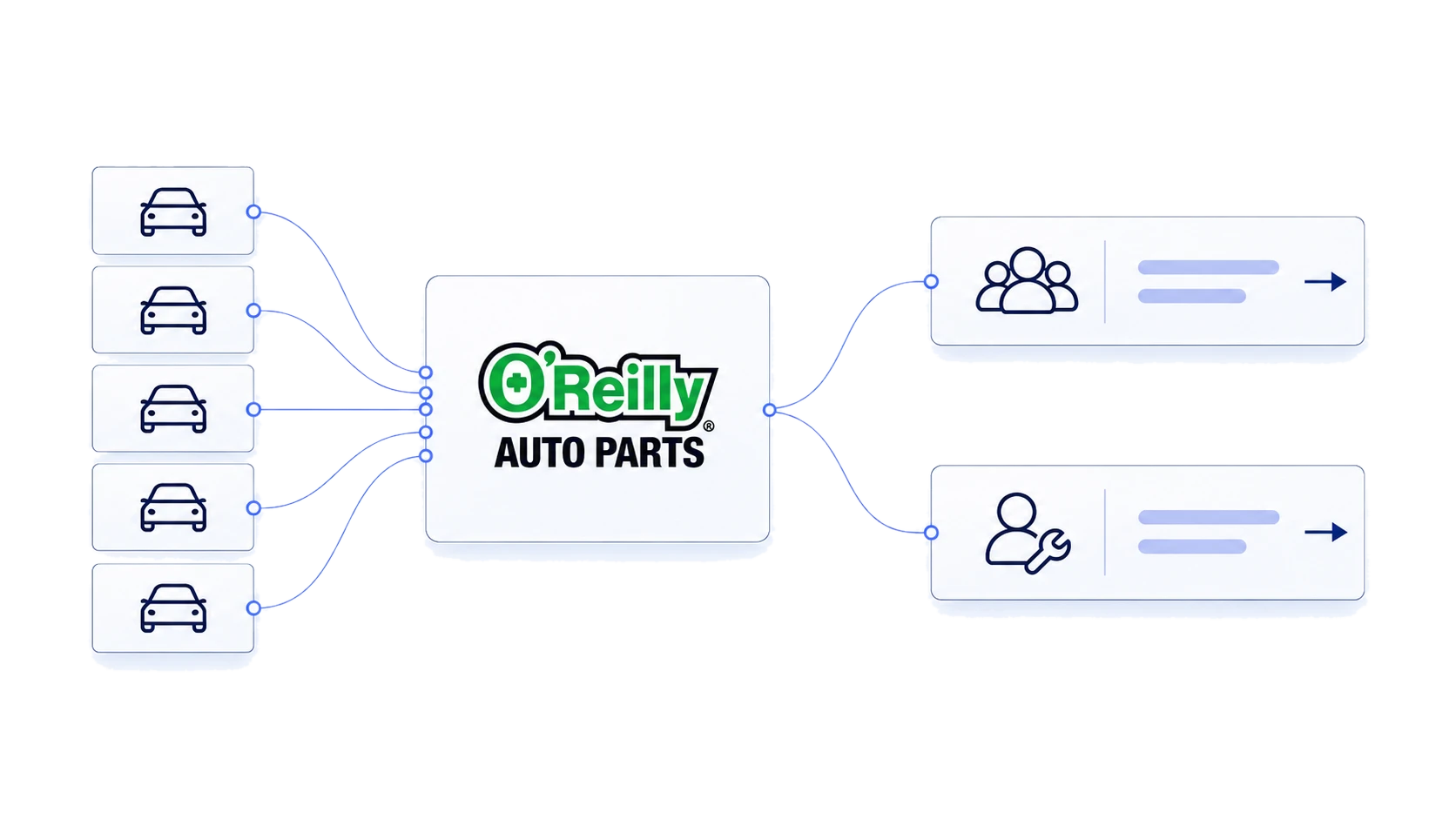
O'Reilly supplies parts to professional repair shops, and those same businesses can participate in its shop referral network. The free diagnostic creates consumer demand, while the referral program directs potential repair business toward shops within O'Reilly's commercial ecosystem.
That's the flywheel. O'Reilly attracts consumers with a free service, identifies a potential repair need, and connects those consumers with businesses that are also its professional customers. The shops benefit from potential new repair revenue. O'Reilly benefits from consumer parts sales, professional purchasing relationships, and a stronger distribution network.
What makes the model particularly interesting is that O'Reilly has opportunities to benefit regardless of who performs the repair. A customer who purchases the part directly creates a retail transaction. A customer referred to a professional shop may generate a separate parts sale through O'Reilly's commercial network. The economics differ, but both paths can benefit the same business. The free diagnostic doesn't have to convert every visitor into a retail customer to create commercial value.
O'Reilly isn't just acquiring customers. It's creating demand for its customers.
The Next Challenge for Marketers
As AI compresses digital discovery and consideration, the opportunity for marketers isn't simply to optimize an increasingly shortened path to purchase. It's to create new reasons for consumers to engage with brands outside that journey. At the same time, consumer engagement is expanding beyond conventional digital touchpoints. From voice assistants and conversational AI to physical retail and human interaction, the paths between advertising exposure, consumer engagement, and commercial transactions are becoming less predictable and harder to measure through conventional attribution.
O'Reilly's campaign illustrates the complexity. A CTV advertisement creates awareness. A free diagnostic motivates a store visit. Technology and employees deliver value. Inventory and repair referrals create opportunities for commercial return across consumer and professional channels. The advertising may influence multiple transactions occurring across different businesses, environments, and points in time.
None of this happens through media execution alone. Marketing, technology, analytics, customer experience, retail, and sales need to work together, aligning advertising promises with what the business can actually deliver. A campaign can generate demand, but converting that demand into revenue depends on what happens after the consumer responds.
Measurement presents another challenge. Not every valuable interaction produces a click, and not every campaign-driven transaction occurs within a brand's owned properties. Connecting advertising exposure to in-store activity, professional referrals, and downstream sales requires combining imperfect signals, measuring incremental business impact, and looking beyond conventional digital attribution.
The commercial impact of a campaign can extend far beyond the channel where the advertising appeared. As the digital journey compresses, marketers need to think beyond individual channels, work across the business, and measure the revenue their efforts influence, even when the transaction happens somewhere else.
O'Reilly understood that the opportunity wasn't necessarily at the point of purchase. It was at the moment of uncertainty, before the customer decided where to go or what to buy.
O'Reilly didn't win by optimizing the point of conversion. It redefined the first touchpoint and every engagement in between.