
CTV is no longer experimental budget. It is core video investment. Yet much of the frequency logic governing it still comes from legacy display playbooks built for cluttered, scroll-based environments. That mismatch is becoming more visible as identity resolution improves and attention becomes easier to measure.
For a long time, frequency caps have been treated as a kind of universal hygiene rule in digital advertising. In most media plans, frequency management is set directly inside the DSP and rarely revisited unless performance drops. The prevailing assumption has been that repetition is inherently risky. The fear is that too many impressions will eventually lead to fatigue, irritation, or brand damage. That belief did not come from nowhere. It was shaped by years of advertising in cluttered Web and Mobile display environments where users were surrounded by competing messages while only partially paying attention. People were scrolling, multitasking, and trying to complete a task. In that context, ads were competing for whatever peripheral awareness they could get. Repetition often feels intrusive there because the ad is not the point. It is noise layered on top of intent.
Streaming television, which we now categorize as CTV and OTT, is not that world. Even so, many marketers still treat it as if it were. The reason for this is understandable because the buying mechanics look identical. Display advertising and CTV are both often executed through the same DSPs. The pipes are converging. Cross-screen frequency management is often handled in the same buying platform, sometimes even optimized against shared KPIs. They use similar frequency controls and are optimized through similar dashboards and reporting views. But they are not purchased, experienced, or cognitively processed in the same way. In display, the unit of value is the impression delivered into a cluttered environment. The user is task oriented. The ad is incidental. Frequency caps emerged as a defensive response to overexposure in a system defined by noise. Buyers learned to manage this with tight frequency caps, impression throttling, and conservative reach goals. When repetition stacks on top of clutter, irritation follows quickly.
CTV operates under very different conditions even when transacted programmatically through a DSP. You are no longer buying a specific show against guaranteed GRPs the way you did in Linear TV, but you are also not buying a fleeting, peripheral impression. You are buying access to a persona inside a controlled, immersive environment. There is one screen. One ad pod. One ad at a time. Audio is on. There is no scroll and no competing creative pulling attention elsewhere. The ad is not fighting for space because it is the moment itself. When marketers carry over display era variables like rigid frequency caps without accounting for this shift, they apply safeguards designed for clutter to an environment defined by focus. Frequency becomes something to suppress by default inside the DSP rather than something to evaluate based on what the creative is actually reinforcing.
What makes this disconnect clear is not theory but experience. While watching OTT content across platforms, I was repeatedly served the same Campbell’s ad introducing a cheddar cheese product designed to simplify making mac and cheese. Over the course of a single viewing session, I saw the ad multiple times. Under traditional display frequency logic inside a DSP, this would normally trigger concern about overexposure. It did not. If anything, the repetition made the product easier to remember.
The creative explains why. There was no heavy VO explaining benefits or telling me what to think. The story unfolded visually. I saw a dad and his kids navigating a familiar domestic moment. There was some uncertainty followed by a simple solution and a successful outcome. The only spoken words appeared at the end, and they were delivered through a familiar brand mnemonic. The ad asked very little of the viewer cognitively. It did not try to persuade or argue. It simply showed a moment resolving cleanly. Each repeat exposure felt less like being sold again and more like returning to something already understood.
In a single screen CTV environment, repetition of this kind of creative does not feel aggressive. It feels reinforcing. Because the ad is not competing with anything else, there is no sense of overload. Familiarity deepens instead. The product becomes mentally available without effort. This is how Spot Television historically worked when buyers controlled placement, context, and sequencing. Streaming recreates that dynamic when the creative is built to support it despite being bought programmatically.
The contrast became obvious when something else happened immediately afterward. In the same viewing session and under the same conditions, I was repeatedly served a T-Mobile ad promoting acquisition offers for new customers. I am already a T-Mobile customer. Which means CRM suppression or audience exclusion should have been in place. The first exposure registered normally. The second made the repetition noticeable. By the third and fourth, the ad had become irritating.
Nothing about the environment changed. What changed was the emotional effect of repetition. This ad was transactional and comparative. It focused on price and advantage. Each exposure reinforced the same idea that someone else was getting a better deal than I was. Repetition did not build value. Instead, it reinforced inequity. In a cluttered digital environment, messages like this can sometimes get lost or softened by distraction. In CTV, they cannot. With nothing else competing for attention, repetition feels directed. It feels personal. The same mechanism that strengthened the Campbell’s ad worked against the T-Mobile ad.
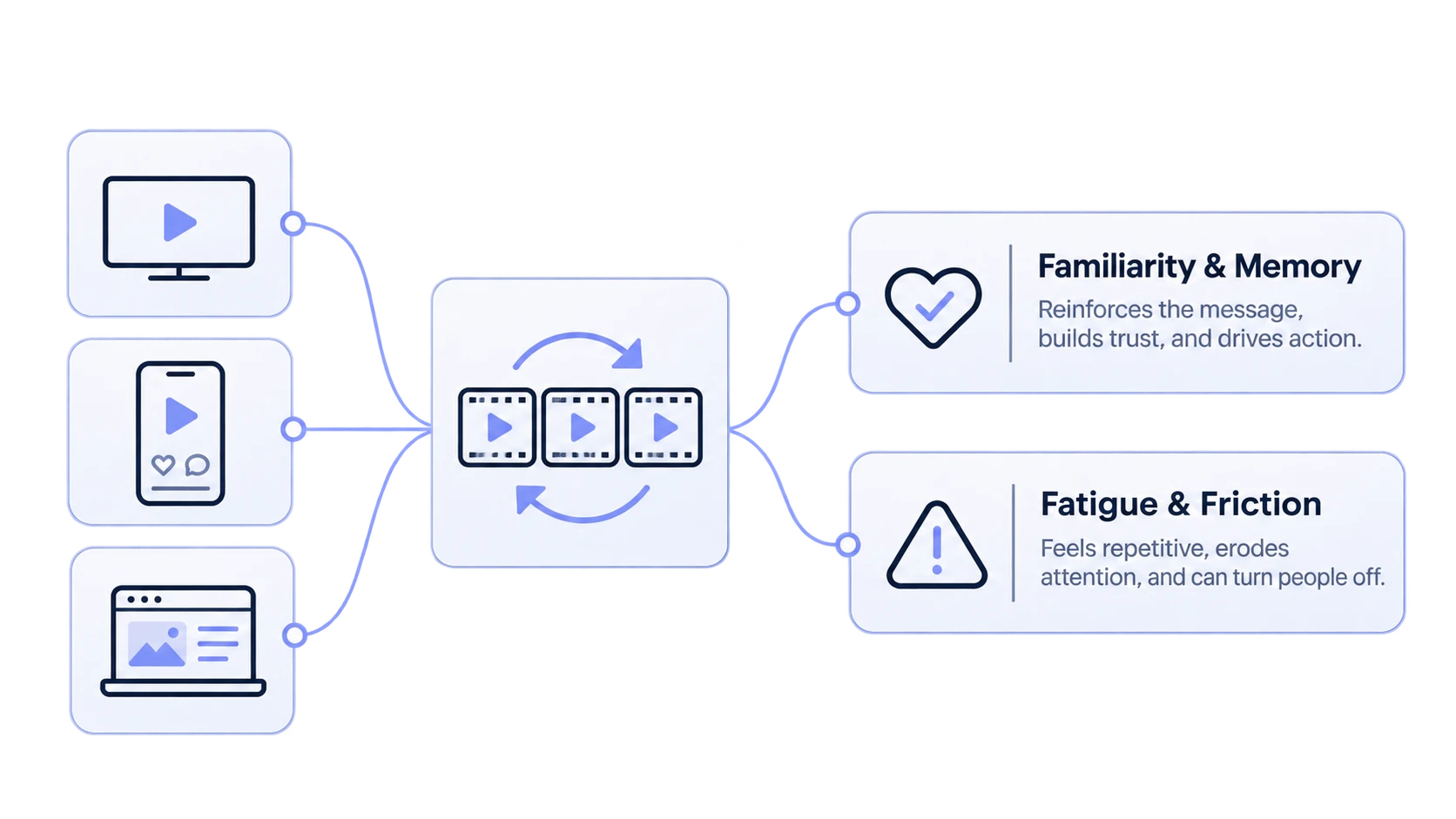
This contrast exposes a flaw in how frequency caps are often discussed. Frequency itself is neither good nor bad. Frequency is an amplifier of emotion. In CTV, where completion rates are high and attention is concentrated, that amplification happens faster and more cleanly than in other channels. As more buyers incorporate attention metrics, completion benchmarks, and in-view time into reporting, the psychological impact of repetition becomes harder to ignore. Repetition intensifies whatever the ad is already doing. When an ad reassures, repetition builds comfort and memory. When an ad pressures or excludes, repetition accelerates irritation.
This is why Campaign Objective matters far more than default media rules. Upper funnel awareness and consideration campaigns benefit from repetition because their purpose is to build familiarity and mental availability. When creative is scenario based and low in cognitive load, repetition works in the viewer’s favor. Offer driven or price focused campaigns behave very differently. They invite comparison. They trigger calculation. Repeating those messages does not create comfort. It sharpens friction. CTV environments do not hide this mistake because they surface it.
Creative decisions further determine how much repetition an ad can tolerate. VO heavy creative tends to wear out faster because it tells the viewer what to think. Repeating instruction becomes oppressive. Dialogue light or silent creative lasts longer because it allows the viewer to observe rather than process arguments. Cognitive load matters more than spot length. A dense fifteen second ad packed with claims will fatigue faster than a slower, narrative thirty second spot. Streaming viewers are not counting seconds. They are sensing effort.
Audience state is another factor marketers often overlook. An acquisition message behaves very differently when it reaches a prospect than when it reaches a current customer. Repetition of an acquisition offer to a non-customer can build motivation. Repetition of the same offer to an existing customer can feel like punishment. This is where suppression stops being a technical enhancement and becomes a form of brand protection. In CTV environments, suppression failures are louder because repetition feels deliberate. Identity resolution gaps and imperfect CRM onboarding inside the DSP make this a real operational risk. Even with improved household graphs and cleaner first-party onboarding, perfect suppression is still a myth. Leakage is inevitable. If an ad can reach existing customers, frequency must come down. The creative must change or a loyalty aware variant must exist. Ignoring this guarantees that repetition will reinforce the wrong emotion.
The problem is not that platforms deliver frequency. They are doing what they are designed to do. The problem is treating frequency caps as a universal safeguard rather than as an outcome of creative, objective, and audience alignment. Frequency management should be planned alongside creative strategy and segmentation logic, not applied as a default setting in the platform. Especially as brands attempt to harmonize frequency across CTV, YouTube, social video, and retail media placements within a unified video strategy. When marketers set frequency caps without considering what repetition actually reinforces, they either leave effectiveness on the table or create unnecessary brand friction.
The shift required is conceptual. Instead of asking how many times an ad should run, marketers should ask what repetition will make the viewer feel. Will it reinforce ease and familiarity or will it reinforce pressure and comparison? That answer should drive frequency decisions rather than a default number carried over from Display.
CTV has not just changed where ads appear. It has changed how repetition behaves. In a single screen environment, repetition is powerful because it is undiluted. When creative earns it, frequency builds memory and affinity in ways digital display rarely can. When segmentation fails or creative is misaligned with objective, frequency accelerates damage just as quickly.
Great creative earns repetition. Poor suppression magnifies mistakes. Suppression should be treated as part of frequency strategy and not as an afterthought. In streaming environments where repetition feels deliberate, serving acquisition messaging to existing customers without acknowledgement is not neutral. It is corrosive. If suppression is imperfect, frequency has to be reduced or creative has to change. Repetition without respect compounds resentment faster than awareness ever compounds value.
The implication is simple even if it is uncomfortable. Frequency is not something to optimize in isolation. It is something to earn. When creative aligns with objective and audience state, repetition builds memory and affinity in ways digital display rarely can. When those elements are misaligned, frequency accelerates damage just as quickly.