
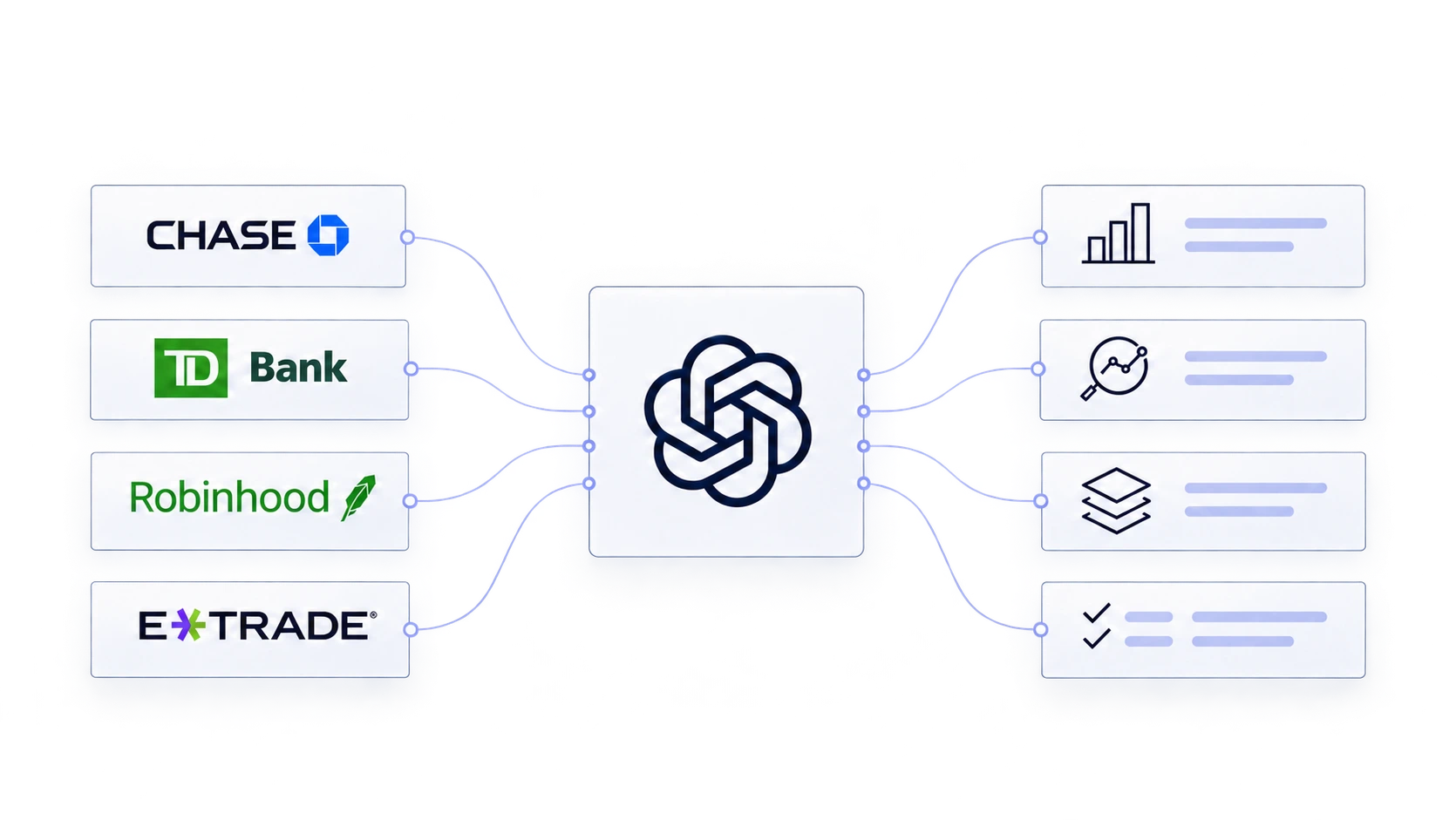
On May 15, 2026, OpenAI quietly moved one of the most valuable parts of investing outside the brokerage.
ChatGPT Connected Finance went live for Pro subscribers in the United States, powered by Plaid, giving investors the ability to link accounts from more than 12,000 financial institutions directly into the ChatGPT interface. Schwab. Fidelity. Robinhood. Chase. Once connected, ChatGPT can analyze your holdings, assess concentration risk, evaluate whether your allocation matches your stated time horizon, explain how macro events connect to your specific positions, and make direct, personalized recommendations grounded in your actual account data.
ChatGPT Connected Finance will answer questions a brokerage AI could never answer directly.
"I bought Tesla at $280. It's now at $240. Should I average down before earnings or wait?" "I have $5,000 to deploy this week. Given my current positions, give me four recommendations on where to invest it." "I'm up 40 percent on Nvidia. Should I take profits now or let it ride through the next earnings cycle?"
ChatGPT will answer all of them, specifically, directly, grounded in your actual account data and current positions. These are not general market observations. They are personalized, account-specific recommendations. The kind that trigger suitability obligations, compliance review, and regulatory scrutiny inside any FINRA-regulated platform.
The only disclaimer: it is not a fiduciary and cannot place trades. But every one of those direct responses would have been stripped, softened, and heavily qualified inside a brokerage environment until little actionable guidance remained.
The difference is not capability. It is jurisdiction. A brokerage AI giving personalized, account-grounded guidance is a regulated act. ChatGPT doing the same thing from outside that environment is not.
Why Broker Dealers Built AI the Way They Did
To understand why this matters, you have to understand what broker dealers were actually solving for when they started building AI into their platforms. It was never purely about investor experience. It was about time on platform.
Broker dealers do not make money from long-term buy-and-hold investors. Revenue is generated from activity options flow, margin interest, payment for order flow. Activity requires engagement. Engagement requires attention. And attention was increasingly leaving their ecosystems for research tools, financial media, and eventually general-purpose AI.
So, broker dealers-built AI into their platforms to recapture it. The logic is straightforward if investors are going to seek analysis and insight, make sure they do it here, inside the ecosystem, where engagement translates into transactions. Keep the investor in the platform. Keep the clock running.
The problem was the moment AI entered the broker dealer ecosystem; it became subject to FINRA oversight. And FINRA-governed AI cannot give investors what they actually want, is low-friction, accessible guidance that reduces the stress of investment decisions without requiring a law degree to interpret the disclaimers.
So, broker dealers spent years and significant resources building AI that technically existed inside their platforms but was constrained from delivering the direct, actionable guidance investors were actually seeking. The compliance layer was not optional. It was the cost of operating a FINRA regulated environment. And that cost meant the product could never fully satisfy the demand investors had developed for the kind of direct, unfiltered guidance they had come to expect from general purpose AI.
When Architecture Determines Regulation
Here is the insight that changes everything and it has nothing to do with models or technology.
When a broker dealer embeds AI into its platform, the output lives inside a licensed, regulated environment. FINRA governs that environment. Recommendation rules apply. Suitability standards apply. The AI is a regulated actor, and everything it produces must be scrubbed, softened, and disclaimed accordingly.
But when an AI platform pulls account data out of a brokerage and into its own environment, the regulatory picture changes entirely. ChatGPT is not a broker dealer. It does not operate inside FINRA's jurisdiction. It is simply an AI that an investor gave permission to read their account data. And once that data is inside the LLM's environment, it can say things that no compliant brokerage AI could ever say.
Similar data. Similar analysis. Recommendations that a broker dealer AI, bound by suitability rules and internal product constraints, could never deliver in that form. Completely different regulatory outcome determined entirely by whether the architecture is inbound or outbound. This is not a loophole anyone engineered. It is an architectural consequence that emerged from the way Plaid-style data connectivity works. The investor consents. The data moves. The LLM analyzes. FINRA is not in the room.
Broker dealers spent years trying to make AI compliant inside their regulated environment. OpenAI moved the environment.
The Dumb Pipe Problem
The implications for broker dealers are structural, not cosmetic. If investor attention migrates to the LLM platform because that is where the useful analysis lives, where the real recommendations happen, where the cognitive experience of managing money now takes place the broker dealer loses the one thing its entire AI investment was designed to protect: time on platform. And when attention relocates at scale, activity follows.
Think of it this way. ChatGPT becomes the brain/ thinking partner. It is where the investor spends forty-five minutes understanding markets, testing assumptions against their actual positions, and building the conviction to act. The broker dealer becomes the finger executing a two-second API call after the decision has already been made elsewhere.
When the brain owns the relationship. The brokerage risks becoming the execution layer. This is not a disappearance. Broker dealers retain durable infrastructure assets: custody, execution, regulatory standing, tax reporting, margin lending, and cash management. But infrastructure assets, however necessary, are increasingly insufficient as a basis for owning the investor relationship.
The risk is not that broker dealers cease to exist. It is that they become utilities. Commoditized execution layers for decisions made elsewhere, with pricing power to match.
The Question Nobody Has Answered Yet
The regulatory vacuum that frees LLMs to say what broker dealer AI cannot also means something else: when the LLM is wrong, there is no governed accountability.
The risks here go beyond classic hallucination (fabricated news events presented as credible, model drift mid-conversation, narratives shifting without warning). Those are real, and they happened frequently enough in early 2026 that sophisticated users pulled back from relying on general-purpose LLMs for consequential decisions. But the deeper risks are subtler: reasoning failures that look coherent but rest on flawed logic, stale market information presented as current, misread user intent that produces a recommendation calibrated to the wrong goal, overconfidence in outputs that carry no stated margin of error.
When those failures happen in a general conversation, the cost is low. When they happen in a portfolio recommendation grounded in your actual account data, the cost is a bad trade. The FINRA compliance layer that made brokerage AI useless also made it accountable. Every output was governed. Every recommendation was documented. There was a regulated chain of responsibility.
LLM finance tools operating outside that framework have none of that. OpenAI has noted that ChatGPT cannot see full account numbers, cannot execute transactions, and cannot act as a financial adviser. But it can and does make recommendations. And when those recommendations are wrong whether through hallucination, reasoning failure, or mismatched risk tolerance there is no regulatory framework that governs the outcome.
The broker dealer that stripped every useful insight from its AI output did so because the cost of being wrong inside a regulated environment was too high. The LLM that replaced it has no equivalent constraint.
This is not an argument against what OpenAI built. It is an argument for clarity about what it is. The frictionless financial intelligence that LLMs now offer is genuinely valuable. It is also operating in a trust environment that has not yet been stress-tested at scale.
The rollout to Pro subscribers is the preview. The expansion to Plus users, hundreds of millions of people making real financial decisions based on LLM recommendations grounded in their actual account data is the stress test. What happens when reasoning failure meets the decision frequency of mass-market retail investors? We don't know yet. And nobody is currently governing the answer.
The Air Gap Is Temporary
Before accepting the dumb pipe outcome as inevitable, broker dealers have two counterarguments worth taking seriously.
The first is execution friction. Right now, ChatGPT can see but cannot do. It cannot place trades. It cannot move money. If ChatGPT tells you to rebalance, you still have to log into your brokerage, navigate the interface, and execute manually. For mass-market retail investors, that friction is a real retention moat. The brain and the finger still live in separate apps.
The second is the regulatory cliff. FINRA moved on payment for order flow. The SEC moved on crypto. Regulators are reactive, not proactive, but they do move. If enough retail investors lose money on trades suggested by a reasoning-failure-prone LLM, the regulatory response is predictable: expand the definition of investment advice to capture any AI providing personalized, account-grounded portfolio recommendations. At that point, OpenAI faces a choice between neutering the product or registering as a Registered Investment Adviser. Neither is free.
The execution friction is a product limitation, not a structural one. Agentic systems are increasingly demonstrating the ability to navigate interfaces and complete multi-step workflows on a user's behalf. The distance between recommendation and execution is shrinking rapidly.
The air gap between brain and finger closes the moment someone ships that agent at scale. Which means the regulatory cliff is the only durable counterweight. And the real question for the industry is a race condition: does regulation catch up before the agent closes the air gap?
If yes, broker dealers get a window to reposition doubling down on platform depth, agentic integration like IBKR's human-in-the-loop model, or accepting the infrastructure-first role and competing purely on execution quality and institutional custody. If no, the execution layer gets automated and the dumb pipe outcome accelerates faster than anyone is currently modeling for.
Broker dealers who are watching this closely are probably doing both simultaneously, lobbying to slow the regulatory arbitrage while quietly building open-banking APIs as a hedge. The lobbying buys time. The APIs buy optionality.
Who Actually Owns the Investor?
For twenty years, the answer to that question was simple: whoever held the account owned the investor. The custodial relationship was the relationship. The platform was the interface. The brokerage was where financial life happened. AI suggests something different is forming.
The institution that owns the reasoning process the place where the investor thinks, analyzes, decides, and builds conviction may ultimately own the relationship. The institution that merely executes the resulting transaction is infrastructure.
That is the shift May 15 put in motion. Not a better chatbot. Not a smarter portfolio tool. A relocation of the cognitive experience of investing from a regulated platform constrained from delivering direct guidance to an unregulated one that could say everything.
Broker dealers-built AI to retain attention. OpenAI moved the attention somewhere else.
The compliance problem that paralyzed brokerage AI for years dissolved the moment the data changed direction. What replaces it in terms of accountability, monetization, and ultimately how regulators choose to classify what these systems actually do is the question the entire industry is now sitting with, whether they are ready to ask it or not.