
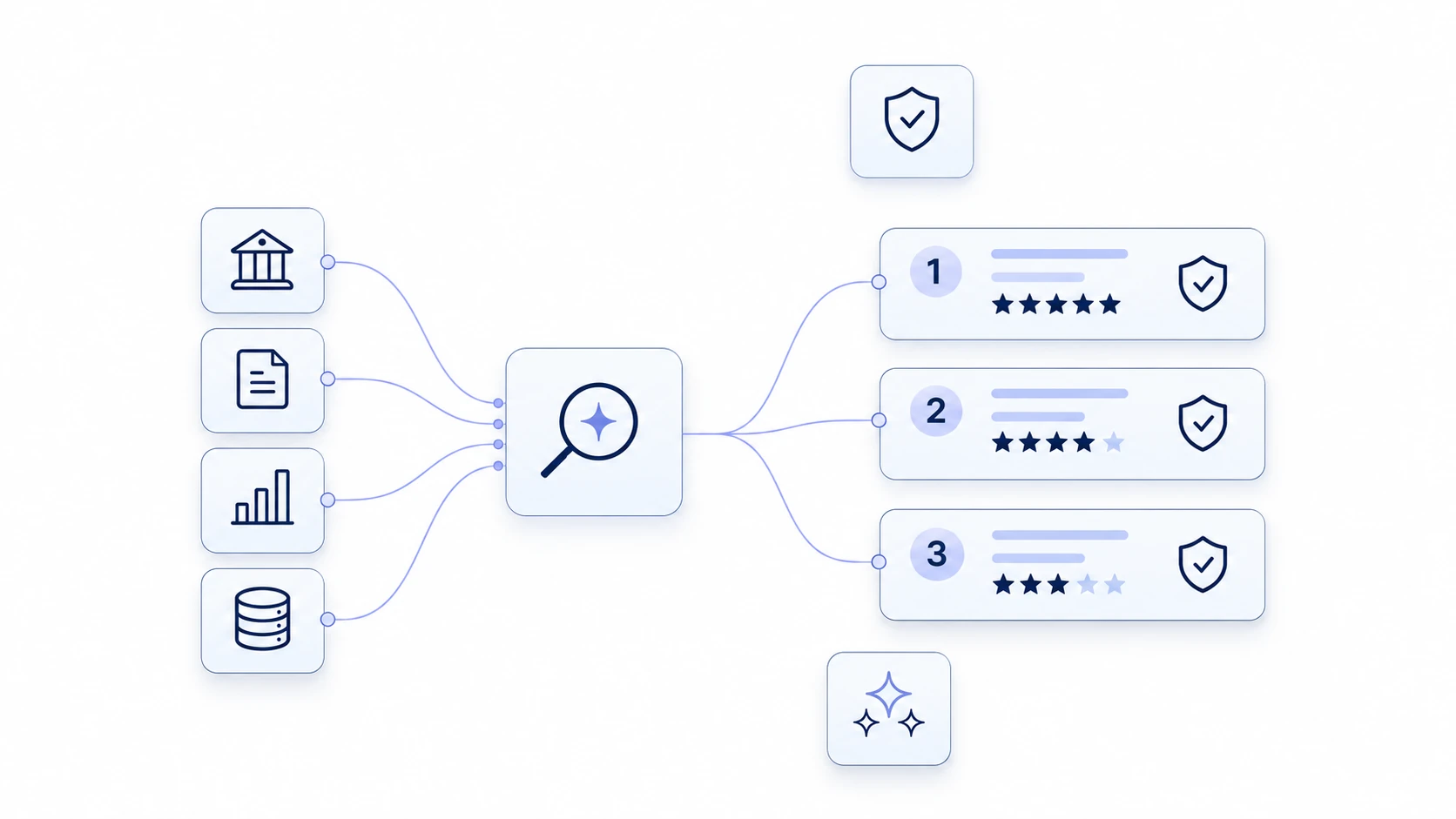
For the last two decades, financial institutions competed for visibility through search rankings, paid media, distribution partnerships, and brand recognition. That's changing now.
When an investor asks ChatGPT which brokerage to use, how a brokerage account works, or which financial institution offers the strongest retirement resources, the AI platform doesn't return a search result. It resolves the question. That changes the economics of discoverability entirely, and it's why financial institutions are no longer competing to appear among the options. They're competing to be the resolution itself.
I came across a recent Meltwater and LinkedIn analysis of 9.5 million AI citations a few weeks ago, and it read like a direct follow-up to something I'd already written. A few months back, in "The End of the Funnell: The Architecture of Eligibility" I argued that Answer Engine Optimization and Generative Engine Optimization get treated as the same thing when they're actually two different problems. One is about whether a model can parse your content. The other is about whether it trusts you enough to resolve to you. The report doesn't reference that framework, but the data in it sits right on top of the argument, so I wanted to pull the thread.
From ranking to resolution
Traditional search worked in stages. A consumer entered a query, a search engine ranked possible sources, and the consumer reviewed a handful of links before deciding. Marketing, design, and brand persuasion did their work somewhere in the gap between the click and the decision. Recommendation and decision were separate events, and the user did the work of closing that gap themselves.
AI collapses that gap entirely. The platform may summarize the category, compare providers, and remove weaker options, but what reaches the user isn't a shortlist to weigh. It's a single answer. The recommendation doesn't sit alongside alternatives waiting to be picked. It arrives as the resolution itself, because the user was never shown what got filtered out. In that environment, visibility is no longer determined solely by whether content ranks. It depends on whether the institution is considered credible enough to cite, structured enough to interpret, relevant enough to include, and trustworthy enough to be the one answer that reaches the user.
Why financial services are different
AI discoverability matters across every industry, but financial services operate under a different level of consequence than most. A resolution about project-management software may affect productivity for a quarter. A resolution involving investments, retirement, credit, or personal financial decisions may affect someone's long-term financial security, which is a very different order of stakes. Financial content has to operate across several dimensions at once: factual accuracy, regulatory sensitivity, product clarity, institutional credibility, consumer comprehension, and current market relevance, all in the same piece.
That's a hard needle to thread. The content most likely to survive compliance review is often highly qualified, generalized, and cautious. The content most useful to an AI system is frequently direct, structured, comparative, and specific. Financial institutions now face a real strategic problem: how do you write something useful enough for AI systems to cite without stepping outside the boundaries compliance, supervision, and responsible communication require? That's not a search engine optimization problem. That's an organizational design problem, and most institutions haven't set up their content operations to solve for it.
LinkedIn is becoming part of the financial information layer
The Meltwater and LinkedIn analysis, drawn from 9.5 million AI citations across six major models, found LinkedIn among the leading citation sources for B2B queries, and ranked second within financial services and fintech specifically. Seventy-five percent of those citations came from individual members rather than company pages, which says something about who should actually be doing the publishing.
The scale here is no longer theoretical. Within Financial Services & Fintech, LinkedIn generated 4,521 citations out of 369,968 tracked in that category, putting it at a number two domain rank ahead of Reddit, G2, and Capterra. Its citation share across tracked models grew 26 percent over a single month of monitoring. This isn't a slow-building trend. It's a channel actively compounding in real time, and institutions that wait another year to take it seriously will spend that year trying to catch up to a moving target.
For years, companies used LinkedIn primarily as a distribution channel: post the news, promote the research, share the executive announcement, recruit, amplify the campaign. AI systems appear to be using the platform for something else entirely, a layer of professional evidence they can pull from directly. A compliance officer breaking down a regulatory change, or a product lead describing what customers are actually doing, can be more useful to a model than a polished landing page ever will be. Every top-cited article in the study used lists. Ninety-two percent used clear headings. Sixty-seven percent included hard numbers. None of that means every executive has to become a content creator. It means institutional expertise now has to be written in a form a machine can parse.
The five signals of financial AI discoverability
Institutional authority. A model needs evidence that a source knows the subject: regulatory standing, years in the business, executive credentials, original research, a track record on a specific topic. Brand recognition helps, but the authority has to show up in the content itself, not just implied behind a logo.
Structural clarity. This is the signal the data speaks to most directly. Models pull information more easily from content organized around clear questions, headings, comparisons, and criteria than from a well-written but loosely structured narrative. Across the top-cited pieces in the dataset, the median length was 1,725 words, long enough to say something, short enough to stay focused. Every one used bullet lists. Ninety-two percent had clear section headings. Sixty-seven percent included hard numbers. At this point that's closer to a specification than a stylistic preference.
Evidence density. Vague statements rarely get cited. Named products, attributed research, specific dates, defined terms, regulatory references, quantitative findings, and transparent methodology are what make a claim verifiable, and verifiable claims are what get pulled into a resolution.
Independent expert participation. Corporate content sets the official institutional position. Individual voices bring interpretation, experience, and judgment, and financial institutions need both working together. This has moved past being a nice-to-have. Seventy-five percent of LinkedIn citations across every major AI model come from individual profiles, and that holds even on Copilot and GPT-5, the two models with the highest company-page citation rates in the entire study.
Trust consistency. A model can encounter a company through its website, its regulatory filings, media coverage, an executive's LinkedIn post, or a customer review. Contradictions across any of those sources cost trust. Language, claims, and product descriptions need to hold together everywhere a model might find them, not just inside one carefully written asset.
Two signals, not one
Worth separating those five into two categories, since conflating them is where most institutions waste effort. It's also the exact distinction the Meltwater data ends up confirming, even though the report itself never draws the line this way.
AEO governs extractability, whether a model can parse and reference your content at all. GEO governs entity-level trust, whether the model has accumulated enough evidence, over time and across sources, to be the answer it gives rather than one of several it considered and discarded. Structural clarity and evidence density are AEO signals. Institutional authority and trust consistency are GEO signals. Independent expert participation sits between the two, individuals doing the structural work AEO rewards while carrying enough real credibility to feed GEO at the same time.
There's a further wrinkle worth naming here. AI platforms frequently generate an answer first and attach citations afterward to support it, rather than synthesizing the response directly from the cited source in real time. That means appearing in the citation list doesn't guarantee your content shaped the actual language of the resolution. Your link can sit at the bottom of an answer your institution had no real hand in writing. Extractability gets you named. It doesn't necessarily get you heard, which is exactly why treating AEO as the whole game rather than half of it is a mistake.
Most of the current conversation around AI visibility treats this as one lever. It isn't. Extractability without accumulation is a fraction of the game, and the industry keeps optimizing for the fraction it can measure this quarter instead of the whole it's actually competing on. That's the real contribution worth making here, not a new acronym, just insisting on the split most vendors and most institutions are still collapsing into one.
I have a personal reference point for why that split matters. I started in paid search in 2000, back when placements sold on CPM and Quality Score didn't exist yet. For a while, the market ran almost entirely on raw bid volume, which meant a mediocre advertiser with a bigger budget could simply outspend a better one. Once Quality Score arrived, it forced the auction to weigh relevance and landing page experience alongside the bid itself, and money stopped being the whole story. AEO and GEO look like the early stages of the same correction playing out inside a different kind of system, except this time the discipline is being applied by a model deciding who to trust, not an auction deciding who to rank. I've watched this exact pattern play out once already. A channel rewards raw presence at first, then gets disciplined by some mechanism that punishes low quality, and the operators who adapt early get years of advantage over the ones waiting for certainty.
The report is, functionally, an AEO field study.
It's worth being precise about which half it actually tests. Every top-cited article uses lists. Ninety-two percent use headings. Median length is 1,725 words. Seventy-five percent come from individual profiles. None of that touches institutional credibility directly. It measures what a model could parse cleanly enough to cite, and stops there.
That gap shows up in the report's own examples. The top-cited financial services pieces include titles like "top crop agricultural insurance companies," "top commodity trading platform companies," and "25 best parking management system solutions." These aren't institutional authority winning the citation. They're format winning it, a numbered list with clean headings, written by an individual account with no evident brand-level standing behind it, outcompeting content from firms with decades of regulatory history and market presence.
That's not a flaw in the report. It's the mechanism I described in the earlier piece. When structure and credibility get treated as one lever instead of two, structure wins by default, because it's the only one a model can verify at the moment of citation. Credibility gets built over time, across sources, in a way no single article can establish on its own. A compliance analyst's 1,500-word breakdown with a comparison table will out-cite a fifty-year-old institution's unstructured brand essay, and not because the analyst is more trustworthy. Trust was never the variable being tested in that comparison.
For financial institutions, the practical takeaway is that structured content is necessary but doesn't finish the job. It buys extractability. It doesn't buy the second layer, the accumulated, cross-source evidence a model needs before it's willing to stake its own credibility on making you the resolution to something as consequential as a retirement allocation or a brokerage comparison. Firms chasing only the first layer will show up in more answers and win fewer decisions.
The website becomes an evidence library
The financial services website isn't disappearing, but its function is shifting. It used to serve as the destination: attract the visitor, make the pitch, convert them. In an AI-mediated journey, it functions more like a supporting archive for decisions that may get resolved somewhere else entirely.
That raises the value of transparent product information, well-maintained educational content, original research, structured FAQs, named authors, real methodology, current market commentary, and a clear line between education and personalized advice. The page isn't only persuading a human visitor anymore. It's supplying evidence to whatever system is evaluating the institution on that visitor's behalf, often without the visitor ever knowing that evaluation took place.
The real competitive risk
The danger isn't disappearing from search results. It's staying visible while losing influence at the exact moment that matters. A firm can have strong brand awareness, solid traditional rankings, heavy media spend, and millions of site visits, and still lose the resolution to a competitor whose information is simply clearer and easier to verify, because when an AI platform is asked to compare options, it favors the source it can parse and trust with the least friction.
That creates a distinction worth sitting with. Awareness determines whether the consumer recognizes the brand. AI discoverability determines whether the brand becomes the resolution. Financial institutions can't buy their way out of that gap through media alone. They'll need to earn eligibility the way any other credential gets earned, over time, across sources, through consistency rather than spend.
What financial institutions should do now
The first move isn't publishing more content. It's figuring out what people are actually asking AI systems before they make financial decisions: how to compare brokerages, what a product's real risks are, how fees erode long-term returns, what separates advisory accounts from self-directed ones, how to evaluate retirement income options, and what actually makes one provider more trustworthy than another.
From there, institutions should check their existing content against those questions and ask whether it answers them directly, credibly, and in a form a model can reliably parse. The institutions that get this right will combine real institutional content, visible executive expertise, structured education, original data, and governance that allows useful communication without crossing regulatory lines.
The next competition
Financial marketing has always run on reach, persuasion, and conversion. AI adds a layer none of those three account for on their own: resolution. An AI platform doesn't just influence a customer's evaluation. It replaces it.
The next phase of this won't be won by whoever publishes the most or spends the most. It'll be won by whoever builds the clearest, most credible, most useful body of evidence, so that when the AI platform resolves, it resolves to them.
The competition isn't simply to be found anymore. It's to be the resolution.