
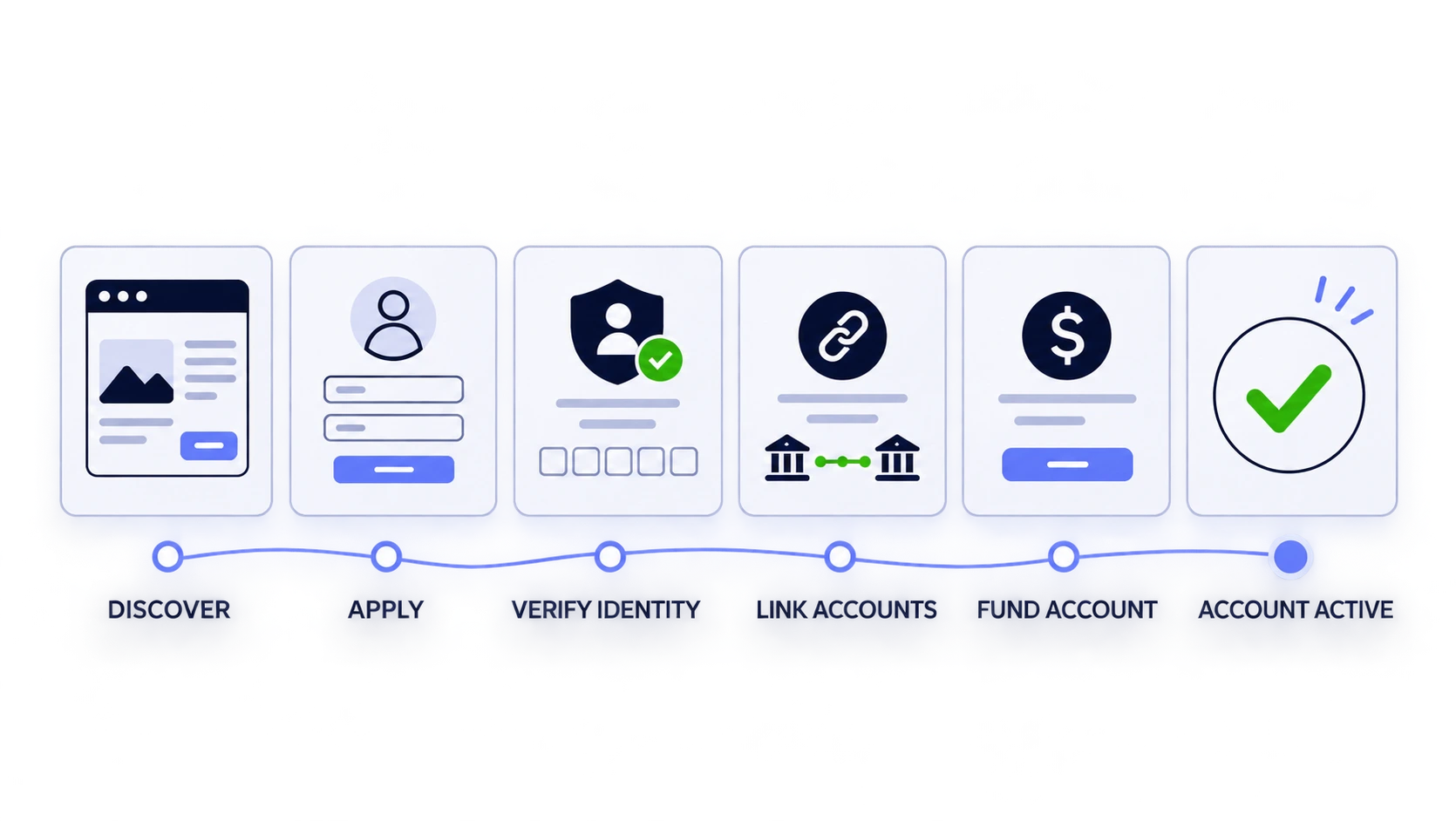
Digital marketing challenges banks and credit unions face today are often misunderstood. Most institutions are not struggling to generate traffic. They are struggling to convert it. It breaks in the middle, where intent is highest and friction is most damaging.
The Wrong Conversion Event
In my experience, most banks and financial institutions are good at generating traffic but lose users between account start, identity verification, and funding.
To drive real growth, banks must optimize for the funded account, not the application submitted. Most banks are measuring the wrong conversion event. Starting an account is easy. Funding it is the real moment of commitment, and it is where most users drop off. This requires shrinking the friction in KYC and treating the account-opening window as a high-stakes moment of truth. Most onboarding funnels lose users at identity verification or funding, not at the initial application step. That is where the real leakage happens.
The Trigger Window
If you are not using coordinated, real-time triggers across email, SMS, or push notifications to pull a user back into the flow, you lose that moment. A user starts an application, gets interrupted during identity verification, and walks away. If there is no trigger within minutes, not hours, that account is effectively lost. This is a moment of truth in the customer journey. If communication gaps exist, the window closes quickly and the user does not return to complete the process. Most banks over-index on the initial offer and underinvest in guiding the customer through completion.
Nobody Owns Conversion
There is also a structural issue inside most institutions. Marketing owns acquisition. Product owns onboarding. Compliance owns friction. No one owns conversion end-to-end. The result is predictable. Traffic is optimized. The funnel is not.
Friction Is an Execution Problem
Reducing friction is not always about major system overhauls. Often it comes down to execution. Reducing funding steps, simplifying account linking, and removing unnecessary fields can materially improve completion rates. Perceived effort is one of the biggest drivers of drop-off. Even small UI decisions — like replacing multi-line radio inputs with compact dropdowns — can materially reduce abandonment.
Channel Continuity Over Channel Expansion
Most marketers think in channels. Customers do not. The winning approach is channel continuity, not channel expansion. A user might discover via non-brand search, be exposed to display ads, do a branded search, start an application on mobile, complete it later via desktop, and fund via a retail or mobile app. If those experiences are not connected, conversion drops. If those experiences are not persistent across devices, the conversion kills itself.
The winning strategy is not adding more channels like TikTok or outdoor media. It is building a seamless experience. A seamless journey means that if a customer walks into a branch or calls a center mid-application, the representative knows exactly where they left off in the digital flow. That is not a marketing problem. That is a systems and data problem.
AI Will Rank Your Data, Not Your Brand
AI is changing not just how customers search, but which institutions are even eligible to be discovered. AI will not rank your brand. It will rank your data. Large Language Models do not browse like humans. They ingest structured data and prioritize what they can verify and cite with confidence. Many banks bury their most competitive rates and terms inside PDFs, images, or inconsistent table structures. To an AI agent, that data is invisible.
If your product specs are not exposed in a structured, consistent format, you are effectively opting out of the next generation of customer discovery. We are moving toward a world where SEO becomes data architecture. Your visibility will depend less on keywords and more on whether your rates, fees, and product attributes are machine-readable. This is already happening in other industries. The same dynamic is now reaching financial services.
The Incentive Trap
Most banks over-rely on incentives to drive growth. Banks have over-trained themselves to buy growth through sign-up bonuses. While a $200 incentive drives volume, it does not drive quality or long-term engagement. The durable strategy and the biggest missed opportunity is post-click optimization. Most banks do not have a traffic problem. They have a follow-through problem.
Banks spend heavily on acquisition but underinvest in onboarding experience, funding flows, timing, and behavioral nudges during account setup. Growth is not found in the ad buy. It is found in the moments where a user stalls mid-application and is pulled back in through the right trigger, or when a multi-step funding process is reduced to a near-instant experience through better integration.
From Transactional to Partner
Banks need to move beyond transactional positioning. Customers are not just choosing a place to store money. They are choosing a financial partner. That requires clear articulation of value across banking, lending, and wealth solutions. It also requires communicating a balance of digital convenience and access to real human support through sequenced, multi-channel messaging that builds familiarity and trust over time.
The banks that win won't be the ones that spend the most. They'll be the ones that stop losing customers after they've already decided to open an account.